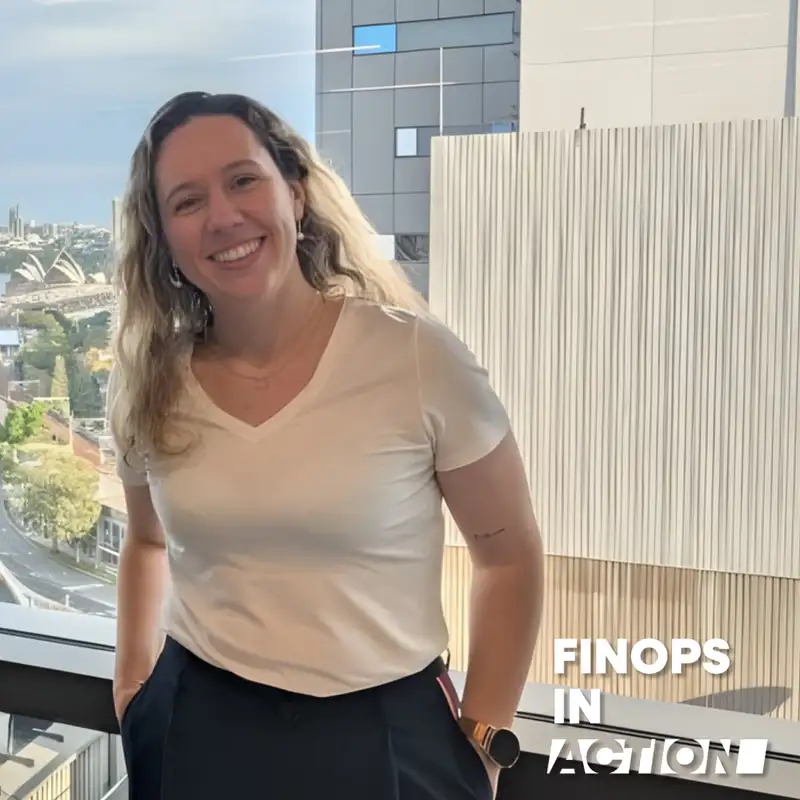
How Culture, Governance, and Visibility Drive Business Value ft. Tamara Lajara, SoftwareOne | Ep #57
FIA - Tamara Lajara
===
Tamara Lajara: [00:00:00] It's about bringing value. We talk about FinOps and we talk about business value. It's not just about sending some reports that are standard, sending that information.
That's it. people te knowledge that they have and the process. So this is how I try to think about value. What a little bit of each. The customer will focus on one usually, but we try to bring a little bit of each.
Intro: Welcome to FinOps in Action. I'm your host, Taylor Hauck. Each week I'll sit down with FinOps experts to explore the toughest challenges between FinOps and engineering. This show is brought to you by 0.5, empowering teams to optimize cloud costs with deep detection and remediation tools that actually drive action.
Taylor Houck: Hello, and welcome to another episode of FinOps in Action. Today I am super excited to be joined by a guest who's had the opportunity to work with FinOps teams across many industries and levels of maturity. She's a certified FinOps professional with over 10 years of consulting [00:01:00] experience. 2025, she was a finalist for the channel company's role model of the year award. FinOps principal consultant at Software One. Tamara Lahara, welcome to the show.
Tamara Lajara: Thank you very much for having me here. Taylor, thank you very much for the invite. It's
Taylor Houck: Oh,
Tamara Lajara: a pleasure.
Taylor Houck: I am. I'm so excited to get into things with you, Tamara, because the reality is that there, there aren't that many people that get the opportunity as a consultant does to see so many different FinOps practices in action. I'm curious from all of the, You know, teams that you've worked with, where do people go wrong in their FinOps journeys?
Tamara Lajara: Sure it's, we have first point of access to see all the learnings and the successes from the company. Is, I think where people go wrong is when they don't align all the points with the technology. So they, when they don't align people's, people process, [00:02:00] uh, and technology together, when they think about one in specific only, or prioritize one in specific instead of the other ones when they don't combine the three of them to benefit the company.
Taylor Houck: Where do you think people, like, where do they lean too far? Like how, how do they, uh, fall into this trouble?
Tamara Lajara: It is interest because it depends on the organization, depends on the culture. The culture is so important and I don't think we value enough. It's. The same team. Sometimes the infrastructure teams that have the same activities have the same interest. They can be so different in different companies. Some companies prioritize technology because they see this as the main goal, the main, uh.
Point of difficulty being a resource that they can get. Why other companies prioritize potentially the process making everything so stuck And so standard that they cannot move outside of that. So I think it depends on the culture of the [00:03:00] organization.
Taylor Houck: And Tamara like, what? For companies that are bringing you in, right? And
you're working
Tamara Lajara: Yes.
Taylor Houck: To establish their their FinOps practice, what are the core goals that you're coming in and trying to accomplish when you're kicking off an engagement?
Tamara Lajara: Yes, I think important. It's about bringing value. We talk about FinOps and we talk about business value and. It's very important for the consultants when we are provi providing service to companies to also think what value we are bringing to our customers. It's not just about sending some reports that are standard, sending that information.
That's it. I really try to adapt. Our hours with the customer to make sure that we bring value. We have a privileged position. As consultants, we can really see kind of like an eagle eye. We can see the macro view that the customer does not has this easy access because they are so involved in that culture that they don't have this visibility.
So [00:04:00] we can see the points that they should focus or potential that would benefit them in some shape or form, and we can bring this to the customer. And this is where I think it's the benefit and where I try to get the value to the customer, bring this value to the customer.
Taylor Houck: So. Of value. Like let's get specific, what? What are you measuring?
Tamara Lajara: me. It's interesting because value is a word that it's a concept that it is hard to measure, right? It's hard to say what it is value really. I try to think about four pillars. I try to think about one optimization. Some customers, they are really focusing to us as expect in terms of bringing savings. So if this is the goal, this is the objective, try to think about this.
Okay. How much I can bring in terms of savings, if this is how you are measuring some other customer's potential is governance, potentially they want to improve this, I also think about, so it's. Optimization, governance culture. Some customers they are, it's, it's very interest to see how [00:05:00] some, usually we are not mature as some countries here in Europe.
They are not mature as the United States. But we are seeing a lot of customers and a lot of increase in the maturity levels of UK and Europe. And some customers they are bringing. To consultants in FinOps looking for improvement in their culture, looking to improve the visibility and the accountability specific from their, uh, environment.
And the last one is the visibility, which is related usually with the reporting and making sure that they have a structure to bring this. So again, straight to align all those, the people te knowledge that they have and the process. So this is how I try to think about value. What a little bit of each. The customer will focus on one usually, but we try to bring a little bit of each.
Taylor Houck: It's interesting, right? Because I, I think that one thing that we really have going for us in this industry, right, in FinOps, is the [00:06:00] fact that the value can be so real and tangible and like seen, right? Because we're talking about dollars and cents. And it's funny that when you start talking about money, You know, people's ears, You know, kind of perk up
Tamara Lajara: Yes,
Taylor Houck: can get their attention pretty easily. And how do you see, like, the reality is that at the end of the day. Savings. Right? The tangible cost savings, cost avoidance that you drive within these FinOps programs, that's how you're gonna get measured, right? But it's the people, the process, the governance, the
reporting
that lets you see and feel that value. Where do you see it all coming together?
Tamara Lajara: I think a lot of, we are measured by values. It's how we present ourselves. If FinOps team, if the person who is doing FinOps is presenting themselves as, I just bring value, I just bring optimization. I just bring the savings. And these are all the savings that I can do. You will be seeing [00:07:00] and will be seeing FinOps as this.
I would like to think that FinOps is more than this. It's really about how can I improve the cloud state? How can I improve the process that we have in in place, potentially tax, for example. We'll not bring a short term value to the organization. They'll need to sit down, think about this, making sure that they are implement and make sure that we have some automation in place, right?
If you think about this, we just. Be spending time from the engineers that could be doing some right sizing, like something different. But in the long term, the improvement that those tags will bring in terms of visibility of the cost, right, in terms of the accountability that will bring, hopefully, will bring a lot more savings than just that, those hours that engineers were just doing that short term work.
Taylor Houck: It's a great point, right? Because the, the effort that's spent on say, implementing a mature tagging strategy, don't see the direct ROI from doing that, not
right
away,
Tamara Lajara: [00:08:00] true.
Taylor Houck: but it pushes that accountability,
right?
Tamara Lajara: Yes.
Taylor Houck: then when you have these savings opportunities that come up over time. You'll know who the owner is for a specific resource, and it helps you drive those optimizations in a more efficient
way.
Tamara Lajara: Yes. And that's why I think the FinOps should also. Be more clear in terms of, look, all of this tagging, for example, the, as you mentioned, the maturity of this tagging, this was my work, I support this, I help create this. So if they are seeing not just as someone that bring in the optimizations or being seen as a paying for the infrastructure team, for example, if they are seeing a supporter and making sure that they see all this other.
Benefits or the other improvements, they will not be seen just for the value of the dollars.
Taylor Houck: Let's talk a little bit about this, right?
Tamara Lajara: Mm-hmm.
Taylor Houck: that you're, you're hitting on is getting that buy-in from engineering teams to work with you along this journey, even when. [00:09:00] The value isn't immediate or, or apparent. How do you, how do you get these teams engaged and kind of to come along for the ride?
Tamara Lajara: Yes, and this is another point in which in understanding the culture and finding the right motivation, it's very tricky. Um, I have seen customers. Before that they were very interested in sustainability. For example, I have one in specific that really surprised me. Major, major Indus industry, a huge organization, global.
They were really interested. The engineers, they were just thinking about sustainability. They were not thinking about how much they were sa they are saving while some other ones, they were very much cost driven. I have one right now, uh, one customer that they are very, um, driven by positive reinforcement.
So they like to be seen as look how much I have saved to the company. So if we just do some [00:10:00] simple boards, which work, kind of like the beginning from FinOps, right? Something that. If we just do some simple boards and put their name in there, they will start to compete to make sure that they hit that board.
'cause they want to be in Dallas to be seen as, look, I did all this. So it's really about finding the right, uh, motivation and driving for this supporters. Yeah, for these teams.
Taylor Houck: It's such a good point, and I've, I've actually experienced this as well, right? Because, I mean, for me, won't lie, I'm, You know. Financially motivated, right? So when I see the dollars and cents and I've had hands on roles, You know, implementing optimization strategies, making infrastructure changes, designing applications to be cost efficient, and like seeing the dollars and the cents, the financial impact, that was very motivating for me. But When you start working with other people, you see not everyone is the
same.
Tamara Lajara: Yes.
Taylor Houck: I actually had a similar experience to what you [00:11:00] just described, where one of the engineers that I was working with didn't seem to care all that much about the cost savings that were being shown. But when we brought in the carbon impact,
right? Then all of a sudden he was more motivated to take action when he saw that, You know, when you shut down a server for a, as a basic example, or even move from, You know, one instance type to
another, there
Tamara Lajara: Yes.
Taylor Houck: Impact and that could get him moving. Although, You know, for someone else it might be all about the money.
Tamara Lajara: Yes, true. And even with our leadership, we talk about getting the buying right, about being able to show what we do and even to our leadership, I think we sometimes we disregard their motivation and we think that it is just about the dollars. 'cause it's clear. Because we are driven by this. So the other people should be driven by this, right?
It's a logical association, but it's not true. Some, I have more than one customer that came to us paying more for us to drive in culture, [00:12:00] to drive other aspects of FinOps in their organizations. They were not caring about the optimizations. At the time. They say to us that the, their focus was on the culture or something else.
So it's very interesting how. Yes, we do these associations automatically, but we should rethink from time to time.
Taylor Houck: Do you think that. For that specific customer that said, Hey, I'm not worried about optimization yet. Let's fix the culture. you think that's because they had the longer term view, that setting up the culture would lead to greater impact financially later
on?
Tamara Lajara: For sure this customer specific, yes. They were in the process of migrating a lot of, um, their workloads from data center to the cloud. They knew that it would increase. They knew that there would be moments in which this would spin out of control, and they say, I need to make sure that the base is strong, which is so clever, which is so.
Right mind, the right mindset. [00:13:00] I need to make sure that the base is strong so when this moment happen, I know exactly how to fix and, and who do I need to look for?
Taylor Houck: And in, in this case was their organization, were they new to the cloud in general? Like were they or had they had a cloud footprint? And then were also doing, uh, lift and shift
migration.
Tamara Lajara: are hybrid. They have a cloud footprint, but they are increasing the, yeah, their cloud footprint. They are slowly moving more and more to the cloud. So they are aware of the cloud, but they were not cloud native
Taylor Houck: Yeah, I guess that's where I was kind of leading
towards,
Tamara Lajara: Yes.
Taylor Houck: right? Because one thing as again, as a consultant, you get to see, I'm sure is working with organizations of levels of maturity, perhaps even different experience in terms of. The, You know, human resources that are involved. How do you see the difference?
Well, number one, have you worked with companies? Is, is my assumption true that you see both cloud native and maybe [00:14:00] legacy, uh, data center
Tamara Lajara: Yes.
Taylor Houck: That are now working in the cloud? And what's the difference between the mindsets of the, the two?
Tamara Lajara: Yes. I think the cloud native organizations, they are quicker and to realize the importance of one FinOps and the importance of some aspects from FinOps, that sometimes it's not very clear for company that comes from data center. When we are coming from data center, we are thinking about capacity management.
We are thinking about making sure that, uh, all the, we have space that we, we are not thinking about, for example. Using the benefits of instances scheduling in a company that is cloud native, it is thinking about, I just need this machine to be on when I need it. I don't need more than that. They are also thinking about how much this cost will impact in my product or my service.
So they are way more connect to. Concepts like unit economics. They, I, I feel like they are quicker and more agile to realize the [00:15:00] benefits from FinOps than sometimes some other, of course, it's just a generalization, right? There are exceptions, but.
Taylor Houck: And when you're working with these companies, You know, regardless of their level of, of maturity, from your perspective, who, who is it within these organizations that you wanna really partner with, that you really wanna. You know, grab and
Tamara Lajara: Yeah.
Taylor Houck: uh, into the FinOps way.
Tamara Lajara: It's so in because, yeah, I keep repeating, but it is, it's so interesting because it depends on the culture of think the organization. Sometimes I, we have companies coming to us looking for FinOps from finance teams. We have procurement teams. We had the normal as infrastructure, we had FinOps. So it's, it really depends on the dynamics inside.
I have one customer right now that, for example, again, is the culture we have. I have two customers that are in the same position that they are doing some reservations right now. One customer eats a [00:16:00] whole process that they need to get a lot of approvals. They need to think up, they need to get all the values correct before they raise all these forms.
With finance, they have a long and very structured process while the other one, you sit down with me, okay? What residential do we need to do? Let's do it now. Start to do it. That's it. Done.
Taylor Houck: which method do you prefer?
Tamara Lajara: It is just a culture, right? With the other one, with the customer that is more structured, more formalized. I would go and I would like to talk with finance, make sure that they understand the benefit, make sure that they understand when we are, when they are receiving this forms, what it is really, that it is not a normal topics in any shape or form, and understand the benefits of doing this while the other one.
It's more direct, it's more straightforward. They understand the benefits. They know what to do it. Yeah. And they do it,
Taylor Houck: I kind of wanna get tactical here, right? Because [00:17:00] reservations is actually, uh. A, a topic that I think gets brushed over and seen as quite simple when in reality it can be more complex. When you're making these reservations,
Tamara Lajara: mm-hmm.
Taylor Houck: who are you consulting with? Before you click
Tamara Lajara: Yeah,
Taylor Houck: would call the most expensive button on the internet
Tamara Lajara: it's, it's the most expensive for sure. And it is a very, yeah, delicate the button as you said. So it, again, if we have a structure in which the causes allocate right. We have some. For example, I know that this workload belongs to a team in the data and ai. For example, I can go to this team, discuss the reservation with them.
Let's talk about the life of this workload. Let's make sure that we understand how long this will last, right? If everything is on the infrastructure, for example, I know that the team that I need to talk is infrastructure. I know that I sit, need to sit down with them for a few hours. It's not something quick because we need to talk about this.
How much. What we are going [00:18:00] to do? How long are this for? Are you sure about this? Now, some customers, they have this finance blocker, so I need to sit down with finance. Like I said, that finance is one that is interesting to say, okay, we have this, we want to do this. CapEx, how much can we invest on this?
Because. They'll also tell me how much, right. Potentially I'll not have all the reservations that I want to do it, so tell me how much so I can really focus on making sure that I'm investing on the right ones, on the ones that will bring me more discount.
Taylor Houck: I'm, I'm most interested. Right now in talking about those conversations on the engineering
Tamara Lajara: Okay.
Taylor Houck: right,
Tamara Lajara: Yeah.
Taylor Houck: Where, I guess I'll tell you where I've seen it go wrong. I've seen folks commit to inefficient architecture or inefficient resources, and then they're stuck with them. How do you make sure that you're avoiding that
scenario?
Tamara Lajara: Yes. And I have seen that as well. I have seen crazy high levels of [00:19:00] commitments just because they would bring savings and then you go there and try to do any change and it's impossible. 'cause they're stuck in that. How we try to do, it's really working with them. So when I say that it is a few hours, sometimes it is hours to discuss because it's not something simple.
And again, following the low, the low hanging fruits, we try to go for the ones that, let's see which ones can bring more discount. Let's make sure that we hit those. First, let's see how it is a big, always when I'm talking about optimization, when we are talking about things, I always try to think more strategic in a way that, okay, seeing your whole bill, where is that I can make most impact
Taylor Houck: Yeah.
Tamara Lajara: if it's, I have customers that virtual machines not even targeting the third in the list.
So it's not through there. They already have something there. So I try to be strategic in terms, okay, let's see where we can get more benefits [00:20:00] if it is watch machines, if we want to do commitments on this. Because all the right ties are done. And this is usually we have kind of like a order, because I don't want to do commit everything first, just because it's a big savings.
And then, oh, we had this right size to do.
Taylor Houck: Yep. lift, shift, and commit
Tamara Lajara: know exactly which is the normal, right, because it brings more savings, so why not?
Taylor Houck: and by the way, the, uh, cloud providers, account teams like to. Like to tell you about the benefits of these reservations, right? And that's where you get into this lift shift and commit. Oftentimes three year commits,
Tamara Lajara: Yes.
Taylor Houck: then you recognize probably within year one, that you could have made decisions to be more cloud, You know, cloud native with your, with your
architecture decisions.
Tamara Lajara: And that's why I mentioned about the value of consultants, because it's not just about bringing why they do this, because it shows a great number, right? A great look. I save you [00:21:00] this many millions. But when you go deep, did they really save this many millions? Or they got, like you said, stuck in an old architecture in something old that they cannot change now or that they will have some, they will lose some money when they change because yeah, potentially they could, but they will lose money on this.
So that's why I mentioned that it is not just thinking about this, the optimization per se, and just thinking about savings. It's thinking about how can I give visibility for the people that should see this and should make sure that they are able to commit. 'cause Yeah, potentially. It's not the infrastructure team who is pressing the button.
Potentially there is some other team. How can I reach them? How can I change the culture inside to make sure that they know that they will spend these hours with me? 'cause a lot of people think it's a waste of time, right? Just send me the list of reservations. Now I want to make sure that these are correctly done.
So it's. It's very, it's, it's not just about savings, it's about all the other [00:22:00] points. Visibility, governance, culture. Yes,
Taylor Houck: I mean essentially from, from my perspective, you need to make sure that when you commit, you're committing to optimize or
efficient,
yes. know, resources. And that kind of leads me into my next point that I wanna discuss with you. And that is optimization, right? I mean, the reality is there's all the culture, there's all the people, there's all the processes, there's all the governance.
Let's talk about the money, the
savings, right?
Tamara Lajara: Yes,
Taylor Houck: ways to save money. Let's
do cost
Tamara Lajara: yes.
Taylor Houck: How do you find cost savings opportunities?
Tamara Lajara: Yes. I always check the customer because there is no cus it's very funny because we say that and usually things that's so silly. Of course, this is on the top of the service, right? Of course. SCO database, they're expensive. They are in the top five. I have customers that they were not top five. I have one customer that, for example, log analytics.
Was the third more expensive service that they had. [00:23:00] How for a company that was not cloud native was not doing high level of logs analysis or anything like that, or customer like analysis, marketing, it was not the case. So it really goes into. Focus on this customer and how my exper expertise can bring savings for them.
So I check, okay, let's see where it is. Is V machines. Let's work on V machines. If this is the highest spend, if it is SQL database, let's work to make sure that this, I have one customer that has a nice, that I nicknamed the SQL monster because they have a SQL instance. That it is very, it's a legacy and they are using that as kind of basically as that data lake and all the new developments, all the new apps that they are created and that they are building.
Everything is on top of that and that monster's just growing bigger and [00:24:00] bigger and bigger. And because they don't want to touch that, it just goes out of control. And it's very hard when it is out of control to anyone to stop that. So it's really a case in, okay, we need to focus now. We really need to think about this, not just short term, how we can make this work for you in the next year, two, three years.
Let's make sure that we have your data safe. We have your data in a proper architecture. So you can work on this and get value from it.
Taylor Houck: I mean, how do you, how do you build out? a backlog of options. Let's say you
come
into a customer
Tamara Lajara: Yeah.
Taylor Houck: they tell you, Hey, I gotta cut $5 million out of the business. By the way, we get this
all the time right
at
Tamara Lajara: Yeah. Yes.
Taylor Houck: $5 million out of our, out of our budget this year. Well, what are you doing?
How do you get [00:25:00] started on that?
Tamara Lajara: I check the bill first. First and foremost, I check the bill.
Taylor Houck: I.
Tamara Lajara: Where are they spending this? Five millions where we can see some. If we can, we see something that would be easy and low hanging fruit that would help us on getting this. If we cannot, if it is something that we work, let's work together to get this.
Usually I am very privileged because we are in a consultants and we have a team of experts, so I can work with, if it is something like that needs react action, that needs modernization, we can work with this with a cloud team. I can work if it is something that license related, I can see that they are spending a lot.
Let's make sure that we go for the right contract. Let's make sure that we focus on the license aspect to reduce this bill. And I can bring someone from the team that is specialist on this. So it is a team effort because sometimes it goes beyond just FinOps to get this 5 million or whatever. [00:26:00] No magic number we have in mind.
But it depends on the customer. Yeah.
Taylor Houck: I like that answer because essentially what you're saying is you need the experts
Tamara Lajara: Yes.
Taylor Houck: the services you need, frankly. Really smart engineers that understand how the services work, how the application is configured, what are the design constraints to help identify these optimization opportunities and validate
them, right?
Tamara Lajara: And align with the customer. It's not just them saying to the customer, this is the right way that we'll fix it. Right. It needs to be a proper conversation and I think that's where we from FinOps bring the, also bring the value because we bring this collaboration. Sometimes I feel like because they are experts and they are so good at.
What they do, they come to the customer just this is how it should do, and the customer potential has something that is blocking them. How we can work with this blocker, how we can work with challenges.
Taylor Houck: And there, and there's just so much data, right? And, [00:27:00] and the reality is that data is the answer to everything. And when it comes to, You know, these billing models are so complex and there's so many configuration options that are available for any given. Service or resource, right? And there's a math equation somewhere that tells you the break even points of all these decisions.
And it's just a matter of, of getting that data and checking. But number one, someone who's not technical enough won't be able to get that data. And number two, oftentimes you're operating at such a scale that it's not even potentially feasible for an individual to go and and find it
all.
Tamara Lajara: True. And potentially we have, um, because they are so, customers are so involved with the day-to-day operation, they are so much in this operational view. They don't, they, they don't think about all this strategic and this other side about best practice about how to do this or alternatives that they don't see this.
So it's kind of like, bring this to them and make sure that we collaborate with them to [00:28:00] find what best applies to their environment. This
number or not?
Tamara Lajara: I the answer for everything. We'll use that. I'll print in.
Taylor Houck: I mean, the reality, right? Is that like when you're working with, with engineers, sometimes, and I don't blame engineering teams for this at all, but there's this thought, it's like, if if it ain't broke, don't fix it. Right? And you have to recognize that in a lot of ways, You know? They're, they're right to feel that way because if they're being judged on You know, responsive their application is, or uptime, right, make sure that there's, You know, no performance, issues on the downstream application, then they're not gonna be inclined to go looking around for ways to reduce the, the resources that are powering their application. But. where data is the [00:29:00] answer
to
everything. And if
you can
Tamara Lajara: Yes.
Taylor Houck: them with the data that shows them that it is a
safe
choice to,
Tamara Lajara: Mm-hmm.
Taylor Houck: know, make a change and that it would save them whatever the amount is without impacting that performance,
Tamara Lajara: because otherwise, yeah, and I think there's also the aspect about modernization, right, that we mentioned before. Otherwise, the end broke, don't fix it. We end up with things that are legacy and they are running in the way that people don't understand anymore how it is just for the sake of making sure that it's production. We don't touch that.
Taylor Houck: Tamara on the, on the topic of modernization, right? I'm gonna throw at you a future looking question and
I'm gonna put you on the
spot.
Tamara Lajara: Okay.
Taylor Houck: Ai, everyone's talking about
AI
right now.
Tamara Lajara: Yeah.
Taylor Houck: What do you see the impact of AI on FinOps? Do you see FinOps getting more important or, or less important, uh, due to
ai?
Tamara Lajara: I think it is, it will [00:30:00] be more important, but it will be more important in these aspects that we don't, AI will never be able to do. It'll be more important in terms of making sure that people have the right visibility to the, the right data. Uh, making sure that we control the cost, not just on the dashboards and not just on.
Making sure that cost anomalies are seen, making sure that we know when something's going up. It's because of usage, it's because of a proper anomaly. Things that AI cannot really, uh, do well. And yes, I think it will be more on the soft aspects of FinOps that will grow the importance instead of the technical.
Taylor Houck: Amazing.
Amazing.
Tamara Lajara: Uh, yeah, it's the to and it's the thing, right? We are seeing more and more customers coming to us with questions about AI deployment, deployments, uh, questions about even, uh, when we need to bring the experts in terms of AI to make sure that we [00:31:00] understand the architecture and everything that is involved 'cause so many layers, right?
That we are talking about. It gets more and more complicated to estimate the cost. It gets more and more complicated to find optimizations, but I think this is where AI can help FinOps all the talk about explaining this to the customer, making sure that the customer talks with the right people. This is what AI cannot help us, and it needs us.
Yeah, it needs FinOps.
Taylor Houck: Amazing. And Tamara, it's gonna be so interesting to see how it all plays out. I mean, with the
Tamara Lajara: Sure.
Taylor Houck: of
innovation, it's, it's happening so quickly. Um, and it's gonna be fun to, to follow along and, um, I know you're gonna be there, uh, for
the
Tamara Lajara: Imagine in two years we can do a recap. Yes.
Taylor Houck: Prediction comes true. Um, but Tamara, before we wrap, I, I do want to touch on, on one important thing, right? And I, I touched on it briefly in the intro. heard you were a finalist for the role model of the year award. Can you tell me about like, what,
what, tell
me about
this [00:32:00] award.
Tamara Lajara: Um,
yes. I was a finalist for the role model of the year in the award from the Channel Awards here in the uk. It was a lot due to my work in terms of mentorship. I support, uh, some mentorship programs. I think it is very important that I'll not even mention about women right, about us, that we are in a privileged position in terms of being experts.
Making sure that we pass this knowledge. We talk about ai, right? Look how ai, at least in UK, is reducing the amount of graduates. We, we seeing this in the news every time, the reduction of graduates coming to the workforce, making sure that we pass this support to younger generations.
Taylor Houck: So talk to
Tamara Lajara: the way.
Taylor Houck: How have you. Gotten involved in mentorship in, in different ways, and when someone comes and they, they talk to you as a, a young person trying to, You know, get established in their career, what is it that you tell them?
Tamara Lajara: Yeah, I got involved [00:33:00] through different ways. One for the was the FinOps Foundation, which I highly recommend to everyone. It's very well organized and it's amazing program. Um, but I also did through Crayon and Software one. Right. Um. And how I talk it a lot. I, I feel that a lot is about confidence. Of course, it depends.
I don't want to generalize because again, it depends on the person, but a lot on the young generations about the confidence, making sure that they. When they go, I have just one, uh, mentee that came to me and she asked me that she was going to meet someone. She's in a career transition and she's going to meet someone that it is experienced this, uh, career that she wants to focus on.
And she was like, ah, how should I do? What should I do when I meet him face to face? It's my first time meeting someone like that face to face.
How should I behave? Where, what should I dress? Silly things [00:34:00] that people don't really ask like that they will not trust someone, they will not ask colleagues. They will not ask their, potentially, their, uh, managers, their leaders in something that, yeah, as I mentor, I'm.
I have freedom to talk with her and to kind of like guide her, making sure that, no, don't worry, you don't need to pay for her coffee. She knows that she's not expecting that. Making sure that you ask this, make sure that you ask that, and just, yeah, having some, someone as a sounding board for what they, yeah.
Make sure that they don't think that they are imposter, You know, the imposter syndrome.
Taylor Houck: Well, Tom, I think that is, that's so great. And You know, there, there's so much that, You know, you've learned through your, your career and your experience and, and paying that forward to folks that are coming, um, is, is so important and valuable and I, I'm so glad that you were, uh, acknowledged, uh, that, about that great work that, that you've [00:35:00] done through. role model of the year award. So congratulations
Tamara Lajara: I didn't win.
Taylor Houck: a
Tamara Lajara: Yeah, thank you. I didn't win. Just.
Taylor Houck: Well, you were a finalist, and to me that that is a, a great testament to the fact that you're doing great work. And again, I, I, I appreciate it. I'm sure everyone that you've talked to. Um, through your mentorship appreciates it, and hopefully today the listeners have the chance to learn something from you.
Um, thank you so much for coming on the FinOps in Action podcast.
Tamara Lajara: Oh, thank you very much, Taylor. It was my pleasure. Yes, thank you.
Taylor Houck: Awesome. And to the audience, I hope that you learned something today. Uh, and thank you for tuning in for another great episode of FinOps in Action. Tamara, thank you so much for
joining.
Tamara Lajara: Thank you.
Taylor Houck: This has been another exciting episode of FinOps in Action. See you next time.
Outro: That wraps up another episode of Fit Ops in Action. Thank you for joining. For show notes and more, please visit fit ops in action.com. [00:36:00] This show is brought to you by 0.5, empowering teams to optimize cloud costs with deep detection remediation tools that actually drive action.
Creators and Guests