Sales Strategy Meets Practitioner Reality ft. Sean Kennedy and Amanda Wagner | Ep #78
FIA - Sean Kennedy & Amanda Wagner
===
Amanda Wagner: [00:00:00] But I think the myth is that FinOps is something that you finish, right? Um, you don't ever arrive at FinOps. It's something that you kind of repeat over and over again, adapting as engineering changes, pricing changes, business changes, right?
So it's a cycle that's continuous, the inform, optimize, and operate, and then you go back again. So it's almost, uh, switching your mindset to understanding that there's not a finish line. There's not necessarily a finish line. It's more just the next lap
Intro: welcome to FinOps in Action. I'm your host, Taylor Houck. Each week I'll sit down with FinOps experts to explore the toughest challenges between FinOps and engineering. This show is brought to you by 0.5, empowering teams to optimize cloud costs with deep detection and remediation tools that actually drive action.
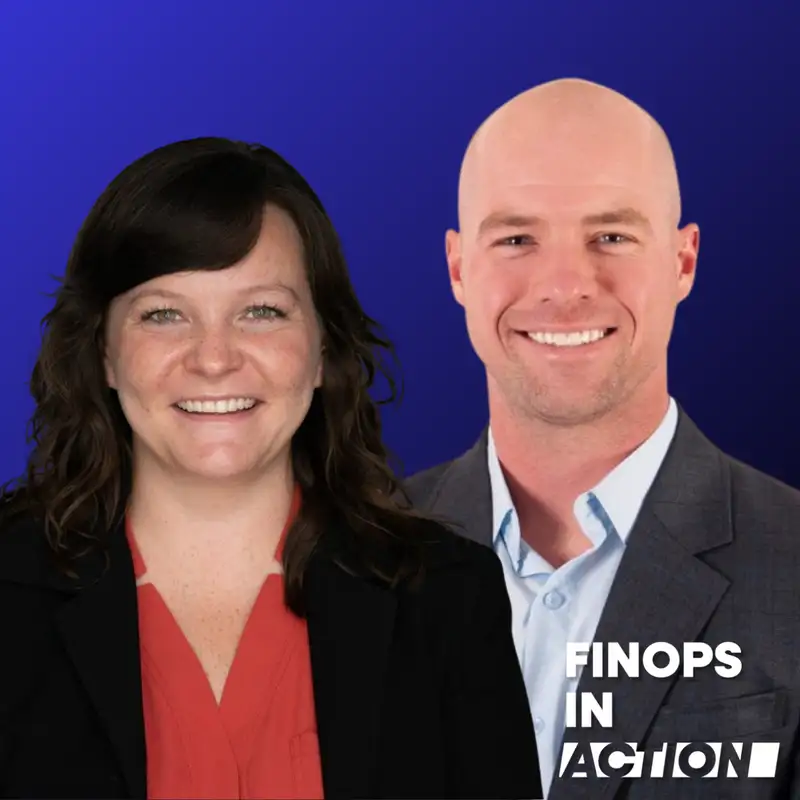
Taylor Houck: Hello, and welcome to another episode of FinOps in Action. Today is a very first for this show. I'm joined by not one, but two [00:01:00] guests. They bring a rare combination of financial, cloud, and go-to-market expertise, and together they represent both the strategic and the operational sides of FinOps. One leads sales and partner strategy for the FinOps team at one of the top IT solutions firms in the country, helping organizations align cloud strategy and execution to drive measurable growth. The other brings a different lens. She spent eight years in elementary education before pivoting into FinOps consulting, and she's become a go-to voice on the practitioner side of the practice. They both come from Trace3, focused on building their multi-cloud FinOps consulting practice. Welcome to the show sales and partner manager, Sean Kennedy, and cloud FinOps consultant, Amanda Wagner
Sean Kennedy: What's going on everybody?
Taylor Houck: Awesome. Before we dive in, Sean and Amanda, I'd love if you could just give the audience a quick, uh, 30-second intro on, on who you are and what you do at Trace3
Sean Kennedy: Yeah, sure. Uh, so [00:02:00] Sean Kennedy , uh, my official title at, Trace3 is a Senior Cloud FinOps Consultant. Um, I work under, uh, uh, Sarah Stone. Um, I've been in the FinOps space for about five years, uh, at this point, and my primary focus is to support all pre-sales efforts within Trace3, particularly focused on the, the FinOps space. So basically making sure that the, the direct sellers within Trace3 are well enabled and well prepared to have these types of conversations, uh, qualifying opportunities for us, and then also engaging with partners of ours, uh, in the space, making sure our team is, is, uh, well-educated on the, the tools and the capabilities that are out there, and making sure we're providing that insight to our, to our clients and, and providing the most, most amount of value possible.
Amanda Wagner: Amanda Wagner, also from the Choice 3 team . More on the operations side, so more customer facing. I have a portfolio of customers that I work with, all with different needs, and I find my best support by kind of matching where they are and helping to support as they evolve through the cloud [00:03:00] and different initiatives put forth
Taylor Houck: Thank you so much. And really, I'm excited to chat with both of you because you're blending this experience of really working with decision-makers and thinking about the high-level strategy and how to push their FinOps practice forward, but also the boots on the ground, real practitioner work that makes this whole thing come to life.
Now, I want to start with you, Amanda, because I know that you have worked hands-on with a bunch of different companies on implementing and improving their FinOps best practices. What's the number one thing that you wish every organization understood about FinOps?
Amanda Wagner: And this might almost seem kind of obvious or right, right there, right? But I think the myth is that FinOps is something that you finish, right? Um, you don't ever arrive at FinOps. It's something that you kind of repeat over and over again, adapting as engineering changes, pricing changes, business changes, right?
So it's a cycle that's continuous, the inform, optimize, and operate, and then [00:04:00] you go back again. So it's almost, uh, switching your mindset to understanding that there's not a finish line. There's not necessarily a finish line. It's more just the next lap
Taylor Houck: And Sean, what do you see when you come in and are working with companies that are thinking about how to improve their FinOps practices? Does that same concept shine through in your conversations?
Sean Kennedy: 100%. Um, it is very much a, uh, a shift in mindset from traditional IT management, right? The, the idea that previously everything was centralized. You, you were doing a, a ton of capacity planning and management. You did one large capital investment, um, and then you basically could more or less set it and forget it, right?
It didn't really mu- matter much how much you were using 'cause you already owned the material. You know, you were supporting other things or, or keeping an eye maybe on the, the, bill and things of that nature, making sure somebody was staffed and capable of, of attending to the actual machinery.
But, uh, the, the difference is exactly the way in which that, that, uh, Amanda had laid out, which is it needs constant attention. It's, it's, uh, it's never [00:05:00] really ending. It's a constant cycle of, of improvement and management, um, across the board. And I'd say one thing particularly for me to maybe take it a little bit further than, than what Amanda had laid out is, is I wish that I think more, uh, organizations recognized it as a organizational adoption, not just one department's focus. Uh, it, it is very much a, a complete total, uh, to- k- kind of total ownership, if you will, uh, by an organization. I think when, when an organization realizes that, they start progressing much quicker to their, to their goals
Taylor Houck: Yeah, and like where I've seen this really come through is, is just the fact that there are so many stakeholders that are impacting the cost of these different services, right? So if you don't get the entire organization aligned, there's not just one person who controls the cost, therefore it can't just be one person that cares about it.
I also think there's this really common, uh, perspective that comes into play, especially when people have perhaps been thinking about cost and got some wins early on of like, "Okay, we realized these savings, we laid [00:06:00] it all out, and now we're, we're done, right? It's time to move on." Amanda, have you seen this come up in, in your work with folks, and where do you think it is where people think that they might be done, and what are they missing?
What are the things that they don't realize is still to be focused on?
Amanda Wagner: Definitely creating those processes, right, and procedures so that you can do something repeatable over and over again and change it, make it better each time, right? You don't want to start to rethink, "Oh, what did we do when we had to, you know, reserve this compute savings plan?" Should already be documented and already be steps in place so that you know what to do.
Because so many times we see company turnover, right? And if we don't have that FinOps culture, well, your FinOps program now left with the person who left the company who had all that knowledge, right? So if we're leaving it with just a single point of contact, a single point of failure, this is not a culture that's gonna continue to thrive when that person leaves.
But if you have [00:07:00] these repeatable processes in place, one person leaves, you can just kind of pick up where they left off 'cause everyone knows what is the expectation for FinOps
Taylor Houck: What are like some examples of these different processes that you would recommend that mature FinOps practices have in place?
Amanda Wagner: Sure. Um, tagging, right? Tag strategy, tag compliance. Do you have some kind of procedure in place so that we know what's running, who owns it? Um, we know the value of anything that's across your cloud, right? Savings. Is there a repeatable pos- process in place to review an action on some of these optimizations?
Can you put in reservations on some of your workloads so that, you know, you're saving money? Um, showback, chargeback, that's another one, right? Do you have appropriate tagging in place so that you can start to go back to these business units and say, "Hey, do you know you're spending X amount on this service," right?
And those questions start to lead to conversations that then make change, or [00:08:00] then you realize you need this procedure, or you need this repeatable process, right? But it's just those conversations that start to take place, and from there you start to develop, you know, something that is repeatable
Taylor Houck: Awesome. And Sean, now I want to kick it over to you, right? Because there's something that we touched on in our prep call that I think is really important and relevant here, and it's that this conversation and the focus areas are not the same at every customer or every company that you work with, right?
And perhaps there are different flavors. I mean, you have enterprises that are very large and have many different departments with different leaders and managers and ICs within them, and then you might have, you know, mid-market or SMB customers as well. What are the differences between the different types of customers that you work with?
Sean Kennedy: is-- That's a great question. Um, and I would say the, the differences really are dependent upon the, the client's current level of maturity. Um, what we generally tend to find is enterprise just because by nature they're larger, they've, they've been probably investing in it a little bit more or a little bit longer than, say, maybe a, a [00:09:00] smaller, more commercial-sized company.
They tend to have more like built-out dedicated teams. Um, they have these processes more, more, you know, properly in place and, and rooted in their kinda system. Um, where I tend to kinda see a lot of enterprise start ra-running up against the wall is when you start getting to the kind of the extreme edges of FinOps, when you start getting into like cost optimization efforts, right?
"Hey, we've, we've pretty much reached, uh, all low-hanging fruit. We've neutralized all, you know, uh, low, uh, uh..." Sorry, uh, wasted spend, right? Zombie infrastructure, if you will. "We've identified all the easy stuff. What, what's next? What else can we do? Hey, we- we're, we're ninety percent covered. I-I-Is there a way to get a hundred percent and, and maintain that without losing any sort of, uh, business value?" Um, so those are the things I think. And, and also, you know, things like cultural adoption, uh, documentation implementation, you know, contract negotiation, you know, with the hyperscalers. They, they, they don't know what they don't know [00:10:00] about the, the commitments and that sometimes those commitments can be pretty daunting 'cause you're talking about multi-multi-year and potentially millions and millions of dollars.
So these are the types of problems I think a lot of the enterprise, uh, uh, kinda clients tend to fall into or, or tend to experience. Uh, the commercial, I, I'd say it's again, a-assuming a, a certain level of maturity, I'd say it's actually just that, is that there's a, uh, a lack of maturity in the space, so they're still kind of, kind of realizing what FinOps is, the fact that it does need to be a, a cultural adoption or organizational, uh, approach, um, understanding that it needs to be more proactive than reactive, right?
So what are the, the three pillars? How do we implement them? How do we make sure that this is being managed, and what are our peers doing kinda looking around? So I'd say it's the, the commercial side, it's they don't really start feeling the pain until they start reaching a certain level of spend, which is when everybody starts paying attention to it. And then at that point is when they start asking the hard questions of: How can we do this better? What, what are the ways in which [00:11:00] that we can improve, right? And then you start seeing that kind of rapid maturity from the crawl to the walk to the run. Um, but they're more table stakes type of-- of needs and, and I'd say problems.
Taylor Houck: Sean, in your experience, what is that level of spend where you think that FinOps really becomes a necessity?
Sean Kennedy: It's a great question. Um, say for a, for a team of one or two people, which a lot of commercial, uh, organizations it tends to be like that ad hoc position that's shared between somebody in finance, somebody in IT. It's a tertiary, you know, kind of responsibility that, that they might be like, "Oh, I got to do this at the end of every week." say in that scenario, it tends to be somewhere between $200,000 to $300,000 a month. I mean, I know, uh, Amanda is much more into the weeds with a lot of our clients, so she might be able to provide a little bit better insight. But that, from my kind of anecdotal experience, tends to be somewhere probably maybe $100,000 to, to, to $200,000 to $300,000 once you start breaching into that spend category
Amanda Wagner: I [00:12:00] would think that's when the C-suite starts asking questions, right? It's like, "What, what is our bill made up of? What are we actually spending?" So I would even say like starting from step one, you're going into the cloud, you're starting to run workloads, tag it. Do you have some kind of like ownership across it?
As companies get in the cloud, right, it's so fast and that's the, the beauty of it, is how fast you can start to spin things up. But they can get out of control really quick. So I think the companies that are really in that more mature phase are the ones who actually understood like, this is something that we need to focus on now because our spend is low.
Once it gets high, it's gonna be hard to backtrack and go back and say, "Okay, we'll tag all these resources with X, Y, Z," right? So creating that posture right when you get into the cloud and starting to form those behaviors is where you're gonna see the most [00:13:00] bang for your buck, right? We're kind of even seeing it now in the space with AI.
There's like the big push to use it, to use it, and now they're coming out, "Oh, there's all these different saving mechanisms," right? Like caching and different things like that. Well, if people would've known that, maybe they would've made, you know, smarter choices when they're going through. Same thing for FinOps, right?
Make those smarter choices in the beginning, you build those habits, and then people continue to, you know, grow and evolve from there
Taylor Houck: I absolutely see the same thing. Like, you're, you're never too early to be thinking about the cost of your infrastructure. I'll give you a perfect example. When I was, like, early on in my FinOps journey, one of my buddies knew that I was, like, into cloud billing. He had just launched a startup and was hosting...
It was like a, a video kind of hosting, uh, platform that was hosted on AWS, and he just, like, shared his screen, we walked through it, and we cut his bill in half. Now, he was only spending, like, 2,500 bucks a month, right? So, like, nothing, right? They're never gonna come and, and work with a consultant because they're gonna pay more for the consultant than they are for the savings they're gonna [00:14:00] realize, right?
So it might not be the best fit for Trace3 or for Point 5 to work with you, but still it's thinking about cost early on in your journey. Now, when you start getting to your spending in the hundreds of thousands per month or the millions per month or the tens of millions per month, hundreds of millions, some of Point 5's customers, several of them in the hundreds of millions per month, they're all seeing the same challenge come through, which is that there's always more opportunity because with growth comes more opportunity and more complexity.
Complexity will find you even if you're thinking about it early on in your journey, that complexity will find you as you grow. Now, I do want to, Amanda, go back to you on the question about this differences in different customers depending on their, let's say, level of spend, size of organization, level of maturity in FinOps. Where do you see the kind of differences lie, and what are the biggest challenges for the different kind of segments of customers that you work with?
Amanda Wagner: The portfolio [00:15:00] of customers that we work with is definitely varying, right? We have some crawls where we're just doing strict visibility, right? Here's what your cloud bill looks like, here's the services you're spending, here's the accounts that it's coming from. And then kind of get more mature from there across our customers.
Um, but like Shawn has said, it's, it's different conversations for each one of those sections, and sometimes that is what makes it complicated, right? 'Cause you're almost saying the same thing multiple different times to try and meet those customers where they are, right? If I'm working with a customer that is just looking for visibility, well, I'm probably not gonna talk about budgeting, forecasting just yet.
We might just have a win by looking at what services they're spending in the last six months, and then naturally those conversations will come over time. It kind of goes back to teaching, right? You're not going to put something in front of a student or a customer if you know they don't have, like, the prerequisites to be [00:16:00] successful.
If you're giving a task to a company to change something, to put in a procedure across cloud, they have to be bite-sized chunks and ready for that customer at that certain point in time, right? So meeting customers where they are is, is a challenge. Um, but I think that's what makes FinOps so unique is that there's not a one-size-fits-all.
Each company has their own unique way of getting to that same bottom line
Taylor Houck: I've got a question for you that might be very hard to answer, and I'd love to hear both of your perspectives on this actually. But there are so many different types of cloud consumers, right? As you're mentioning, you guys work with a lot of different types of customers that look different based on their spend, based on their maturity. Who do you think has the most to gain from improving their FinOps practices?
Sean Kennedy: Who has the most to gain? You mean [00:17:00] persona-wise?
Taylor Houck: I mean, as a, as an organization, right? If you're coming in, is it the mature enterprise that has been thinking about FinOps for a while but is spending an enormous amount of money? Or is it, you know, a, a commercial customer that is, you know, growing and seeing a lot of growth on their kind of horizon but hasn't completely, you know, invested in the space yet?
When you're working with a customer, who do you work with that you are just like, wow, the amount of value they could realize from improving these FinOps practices is the greatest?
Sean Kennedy: I mean, uh, that's a great question, Amanda. I, I don't wanna speak for both of us, so I'll let you answer as well. But in my experience, I think it's the ones that are going through significant change, um, particularly migrating from, say, on-prem to the cloud, right? The, the greenfield, uh, at least again, this is anecdotal, the greenfield, you know, born in the cloud type companies tend to have already like maybe already thought a lot of this through or, or are expecting, you know, this, this type of, uh, you know, constant management style because [00:18:00] it's where they based or, or grew their business from. Whereas some of these larger enterprise or even commercial sized, uh, uh, type companies that have been historically on-prem type technology as the backbone of their, you know, digital presence have a harder time because it's, you know, it's the old adage, right? It's difficult to teach an old dog new tricks when you've been reliant on something so consistently, and that process and methodology, it's, it's difficult to kind of unlearn it, or at the very least, you know, learn something new that could be so categorically different.
So I'd say it's probably the, the companies that have historically been present or singularly present within traditional IT infrastructure on-prem, then shifting into the cloud. That, that's I think where I'd, where I'd place focus
or, you know
Taylor Houck: Sean, and, and Amanda, I'm gonna give you a chance to answer as well, but Sean, I think that is such a perfect answer and I've seen so much value come from even like within a large enterprise. I'll give you an example. I was working [00:19:00] at NBC Universal, obviously many different business lines and a lot of different cloud consumption across a lot of different use cases, right?
You have, let's say, uh, cloud native products like Peacock, the streaming service that was literally created in a cloud-first world, right? That's one set of problems. But then you have, let's say, very legacy infrastructure where you have teams and people and applications that have been around since the mainframe days, right?
And it's the same team managing the infrastructure in the cloud that was managing it in the on-prem world. Now that is where I saw, I'd say, the biggest percentage of spend opportunity when I was there because it's, it's not only about looking at the cloud resources themselves and the utilization rates and thinking about your architecture. It's also about the processes and the people and the way of thinking because the cloud is just inherently different than running in an on-prem world in terms of your availability, in terms of the marginal cost of, say, sizing production the same as [00:20:00] QA or staging or development. Where in the cloud you're really paying for that delta in a way where in the on-prem world if you have capacity, you have capacity.
Why don't you just test it as the same thing? That's such a, a good answer in my opinion. Amanda
Sean Kennedy: no, I appreciate it. And the last thing I'll say is that made me think of this as well is, um, you know, you also have to factor in the human element, right? Like it, it's not just about the process, but people are resistant to change, but, but also have personal opinions and resistance to that change, right?
So they might be not thrilled that the, the, the company has decided to take this direction and, and it's kind of a process in, in convincing and, and educating people of, of getting on board, right? Um, so it's, it's a-- You're, you're having to address that as well, 100%, is people's personal feelings and animosity maybe towards this change and having to, you know, think, really think through.
Because the last thing you want to do is be halfway through, say, a migration and, you know, half of your engineers are not really like, you know, excited about this, right? You know, really want to make sure everybody's on, on the same-- singing, singing off the same sheet of music, [00:21:00] um, and rowing in the same direction, you know, to throw another euphemism at you.
Taylor Houck: Awesome. Now, Amanda, I'd love to hear from you and your experience. Where are the, the cases or the types of customers that have gotten the most value from what you and bringing FinOps best practices have brought to them?
Amanda Wagner: It's, it's funny 'cause they see it all the time that FinOps is a, a culture, right? And it's something that you create across your environment. Um, but I think that is a piece that's sometimes missed. So I would say the most value I see, it's... I'm gonna have two answers here . Are probably those enterprise customers, right?
They've, they've been running in the cloud, adding different organizations as they continue to go along, adding different accounts, and maybe they were so fast-moving that they didn't have those procedures, those repeatable processes in place. So now they're at a point where they don't necessarily have FinOps built out across all organizations.
Maybe they have one, and that one org is not talking [00:22:00] internally to the others to say, "Hey, this is the baseline. These are the expectations that we have." So a really big bang for your buck can be with those enterprise customers and really starting to pull back the layers of what makes up the spend, why the bill is so high, who owns it, you know, what's running and those different things.
But then I'm gonna go back to what I said before. People who are first starting in the cloud, it might be very valuable to start, you know, to, to think about these things and asking some of those harder questions. Because as you start small, you'll be able to, to build on that, right? But if you get to a point where you're already an enterprise customer and you don't have these foundations in place, things might get a little bit more stressful, fall apart, not necessarily continue in that cycle that we want them to
Taylor Houck: I r- I really like the answers that both of you gave to that question because it really shows what I was trying to get at here, which is that the value of, of implementing FinOps [00:23:00] is not unique to one specific, you know, use case or one specific type of customer. Depending on who you are and your level of maturity and your level of spend, you're gonna have different areas of focus and you're gonna get, you know, different value.
And what that value is to you is not so prescriptive. It really depends on where you are in your stage. Now, I wanna touch on another really hot topic that everyone's talking about right now, and that is AI. one of the big things that I'd say people in the FinOps ecosystem or the FinOps world have been talking about for a while now is the expanding, say, scope of FinOps.
Where if you were born, uh, in the early stage of FinOps, like 2019, 2020, it was very squarely focused on, let's say, traditional cloud infrastructure running on AWS or Azure or Google Cloud. Then we kind of saw an expansion into, say, SaaS or, or platform- platform tools or data platforms like Snowflake, Databricks, even Datadog, pretty much all this other usage-based [00:24:00] pricing model, uh, software that was all of a sudden being consumed at scale within these different companies. And now you have this entire new wave of AI. Sean, do you think about the expanding scope of FinOps, and what are the people that you're chatting with thinking most about right now as it pertains to FinOps?
Sean Kennedy: Yeah. I mean, it's a, it's a daunting task. It's moving very rapidly. I know a lot of people are, are s- uh, struggling to, to keep up, right, uh, with how rapidly everything's changing within the FinOps space. But, um, I mean, it's, it's like anything else that people adapt, and I think, you know, within, uh, within AI specifically, you know, it's, it's a something that is important to address when you're having these conversations is clarifying exactly what they mean by they're investing in AI, right?
Um, understanding exactly, because that, that is such a broad term that people use, you know, pretty universally for a lot of different things, right? Are, are you simply purchasing licenses for [00:25:00] Copilot, uh, 365 or Cursor or say, uh, Ask Turing or one of those, right? Glean, if you will, where it's a fixed cost license-based model.
Um, you're leveraging it, right? But, uh, is that, is that what you're referring to, or, or are we referring to hyperscale driven AI investment, right? Are we talking about AWS Agent Core and Bedrock or Azure Foundry or, or, uh, Copilot Studio, right? Uh, any of those types of approaches. Or, or are we talking about the Neo clouds themselves, right?
The Coreweaves of the world, where they're selling space on GPUs that companies can invest in. Or lastly, are we talking about, you know, AI pods, if you will? I've heard that be used by Cisco before. I think some people also refer to them as like AI factories or labs, right? Where they're in-house, homegrown, they're being-- the hardware is being invested at, uh, invested in, so the GPUs are owned, um, by the, by the, uh, the company themselves, and they're creating their own kind of agents, uh, within, [00:26:00] within their or-or own organization.
But now that opens up another kind of suite of problems of GPU chargeback, both internally and externally, and capacity management and planning, things of that nature. So I think clarifying really what they mean and, and what the, what the issues and kind of pain points are, and then being able to address those, uh, you know, as they kind of present themselves.
Taylor Houck: Are there any specific areas out of all those that you spoke about? I thought that was such a really interesting way that you framed it, which is that talking about your AI investment, it's not just one SKU or, or one way in which AI is being consumed. There are so many different ways. Are there any that are, you'd say, um, most being brought up in your conversations recently?
Sean Kennedy: I don't know. Amanda, I'll, I'll default to you. I know you interact with the, the clients the most. I'm trying to think if there's anyone specifically that is more often than others.
Amanda Wagner: Yeah, I would say, um, AI more specifically, the very, like, uh, topics we're seeing are the variations [00:27:00] between seat-based usage and then, um, fee usage, unit usage. Um, so I'd say that's top of mind 'cause it's unknown, right? What's the value of a token? If I'm spending all these tokens, is there anything associated with that, that we can say, "Oh, there's this return on investment because we've saved X,"
Taylor Houck: Another thing that's really top of mind right now from the people that I've been chatting with is trying to understand where AI costs are even going. Because I think that we've seen this very, I'd say, rapid advancement in the capabilities of these models that has taken a lot of people by surprise, right?
Right now we're sitting in June of 2026. If you go back to June of we were nowhere near the level of capability of these models, and now everyone's kind of rushing to take advantage and, and use these capabilities to, you know, improve their business and, you know, stay ahead of the curve. Amanda, I know you wrote a piece on [00:28:00] forecasting AI investment. What do you think are the key elements of forecasting, and how should companies be thinking about what they're gonna be spending when they look back at the fiscal year of 2026?
Amanda Wagner: testing is definitely something that some of our customers are, are dabbling with. Others are kind of turning it on full force to then get a baseline for a month and then kind of go from there. But it's, it's definitely important to kind of get a, a foothold on it while you're starting, um, because it can get out of hand very quickly.
So starting to think about those procedures, right? Are there specific models that we are staying away from as a company? Are there any guidelines that we can give to the users of this to say, "Hey, if you have something that is maybe just question and answer, use this model." Right? So really building that education [00:29:00] across your environment so that you can actually forecast.
Um, you can't necessarily have all those conversations if you don't have the foundational questions answered
Taylor Houck: Amazing. Sean, what have you seen in the same to- kind of topic of conversation when people are thinking about their growing AI costs and how to think about kind of the return on all that they're spending on AI?
Sean Kennedy: Yeah. Um, you know, for the seat-based, uh, approach, I'd say it's, you know, understanding where exactly companies or how, how the headcount is actually leveraging, say, you know, their Copilot or their Glean, right? Is it actually being used, or is it just kind of shelfware? Trying to figure out that, that kind of, uh, uh, measurement. Um, for, for the, the more token-based type of approach, I'd say it's, you know, um, prompt engineering, making sure that the prompts that you have are as, as, uh, kind of tightly worded as they possibly can, the most efficient that they possibly can be. Um, really just making sure all, all of your processes and, and efforts [00:30:00] are as kind of tight as they will, dialed in maybe is another phrase, um, as they possibly can be.
And then, you know, as, as Amanda was saying, I mean, know, you don't necessarily need a ten thousand dollar hammer to drive in a nail, right? Like, not every tool is gonna need to be the most inexpensive tool in order to get the outcome that you desire, right? So, like, maybe determining what models are the best approach for the workloads that you're looking to execute on. It's not always gonna need to be the newest, most expensive model that's available, right? So figuring out, you know, where the workloads are from a planning standpoint, "Hey, these workloads can be run on this level model 'cause they're a little bit less of either a priority or aren't gonna require as much of that kind of cutting edge, uh, type of approach, uh, from a technology standpoint." Um, but yeah, I'd say there's, you know, it's, it's definitely changing. Tokenomics is, is, you know, we all saw FinOps X is, is [00:31:00] top of mind. I think it's probably the, the number one thing everybody was talking about by far. Um, and like anything even within the cloud, right, there'll continue to be evolutions in the way in which the people are kind of approaching it. Um, but right now I'd say it's, it's just trying to be as thoughtful and as, as, uh, uh, of, um, intent-driven, I guess you could say, as you can be to, to keep co-cost down and, and manage it as best you can.
Taylor Houck: The world is changing so fast, and it's gonna be really amazing to look back, right? Once it's all said and done, or it probably will never be said and done, but once more of the dust has settled on what this AI situation is gonna be, to look back and see what are the best practices that emerge and what are the best ways to manage the spend.
Now, we are getting to the end of our-- the time that we have allotted for today, but I really wanna also give you both an opportunity to speak a little bit about the work that you do at Trace3 and how specifically you guys are helping your customers achieve, uh, these, you know, these, [00:32:00] these savings and these wins as we discussed today. Sean or, or Amanda, both of you can maybe, um, just briefly describe what it is that, you know, you guys are, um, are best at, just for the audience to kind of understand the, the lens in which you're approaching this from.
Amanda Wagner: I would say a lot
of it is unknown, still unknown, right? And I, I think the value that specifically I bring to some of my customers is I might not be able to find out the answer. I not, might not have the answer, but I'll be able to find it out, right? So learning on the journey together, um, because this is all so new, and trying to figure out what works and being able to replicate that across customers so that as I continue to work with customers, it just get better and better and better each time.
'Cause like you had mentioned, it's not gonna be the same across our portfolio
Sean Kennedy: that's a great answer. And then for me, uh, you know, since because, you know, I, I deal mainly on the, the sales side and, and partner engagement [00:33:00] side, I'd say particularly on, uh, when engaging with clients, you know, we are uh... We, we, we provide extreme, an extreme amount of value to our clients, but a lot of that is based on trust. and I think trust is built off of authen-authenticity and, and empathy, if you will. So, you know, approaching every, every conversation, you know, whether it's with someone I'm meeting for the first time at a potentially new client, um, of the FinOps team or, or someone that we've worked with and that they're coming to us with a new problem set. Um, just coming to the, uh, conversation in, in just the most authentic and genuine way and trying to put myself as if I, I'm a part of their organization, right? That's-- We always like to, to kind of talk about that. We're, we're not just here to, um, necessarily just give someone a service and walk away and that's it, right?
We really, people like Amanda and our team really embed themselves in their customers and their clients to the point where they're kind of like a, you know, a part of that [00:34:00] organization, right? And I think that level of engagement and kind of, uh, extreme ownership and, and leads to that trust that we've been able to cultivate and that we, uh, we really, really do hold a, a, a significant amount of value, uh, in that type of, uh, trust that we get from our clients.
So I'd say empathy, trust, authenticity is probably where uh, I excel the most, at least in these conversations.
Taylor Houck: Amazing. No, thank you guys both so much for sharing all of your insights that you've learned from working with countless customers, uh, at Trace3. Now, just on that topic of trust and personal relationships, Sean, I do wanna give just a moment here at the end of the pod to maybe not learn from us in a technical, uh, way, but about us as, as people.
Now, Amanda, I said it in the intro, but you pivoted into FinOps after eight years as the elementary school teacher. Now you're a FinOps consultant. How, how does this pivot even happen?
Amanda Wagner: I knew I wasn't gonna retire a teacher. Um, I give it a hand it to all the teachers and all the [00:35:00] parents out there. It's definitely a lot. Um, and I knew I needed something different, right? Um, but the same, same procedures, right, still go. Still meeting customers where they are. I'm patient. I'm communicating the same idea multiple different ways, right?
And just meeting people where they are. It's no longer students. It might just be, um, a customer or a company, but the same rules apply, right? I have knowledge that I need to share, and I might need to get that across in different ways to different people. So a lot of what makes a great FinOps practitioner are some of those things I learned in the classroom: patience, repetition, and knowing to where to meet each person
Taylor Houck: I love that there's always so much that we can learn from experiences outside of our professional world that really shines through. Now, Sean, for you, I know that you come from a, a background of service and have served in the, uh, the military, more specifically the Navy.
Are there any [00:36:00] lessons that you learned from that that shine through, whether it's in FinOps specifically or just in work more generally? A lot of times we just like to give some general kind of career advice to folks that might be listening. Um, I'd love to hear what you kind of took away from that experience.
Sean Kennedy: Yeah. Um, no, I appreciate it. And, uh, I would say in-- from that experience, it, it, it really provided with me-- provided me with a, a extremely strong foundation of, uh, like the, the ability to kind of just be consistent and persevere, right? You know, you-- if, if you're gonna achieve any sort of success in any part of your life, whether it's, you know, going to the gym or it's, you know, taking up a new hobby, whatever it may be, consistency is kind of key, and not being frustrated and just kind of throwing your hands up at the first sign of, of adversity. Um, so, in anything, you know, perseverance I think is probably, in my opinion, for me personally, it's, it's kind of the bedrock of, of my lived experience. Um, so, [00:37:00] and then, you know, from a, from a pro-professional standpoint within FinOps especially, the, the ability to be open to or flexible to change. Um, you know, that's, that's just a kind of core aspect of, of life as well, right?
You know, FinOps community is gonna change consistently. You know, the company you work at is gonna change. You know, people around you change. So, you know, flexibility and, and perseverance and consistency I'd say are, are the three key ones for me.
Taylor Houck: Awesome. Sean, Amanda, thank you both so much for coming on the show. I'm so glad we were able to do this. Uh, if the listeners are looking for more or want to get connected, where is the best place that they can find you?
Sean Kennedy: Yeah. Uh, so you can come to our website. Um, we're also on LinkedIn, so if you, you know, just do a simple Google s- Google search of Trace3 FinOps, it's an easy way to find us. Um, or, you know, come, come find us on LinkedIn. Um, I'm trying to think, is there anywhere else, Amanda, that you can think of other than that? That should be it, yeah. So yeah, anybody that needs any assistance with this type of [00:38:00] stuff or just interested in having a conversation about it, um, you know, to learn more about the industry or, or how we do what we do, feel free to reach out. We love talking to people about this.
Taylor Houck: Awesome. Sean, Amanda, this has been fantastic. Thank you so much for coming on the show
Sean Kennedy: Thank you, Taylor. Really appreciate the opportunity
Taylor Houck: And thank you to our audience. If you got something out of today's conversation, which I'm sure you did, please share this episode with someone who needs to hear it. This has been another amazing episode of FinOps in Action, and we'll see you next time
Outro: That wraps up another episode of Fit Ops in Action. Thank you for joining. For show notes and more, please visit fit ops in action.com. This show is brought to you by 0.5, empowering teams to optimize cloud costs with deep detection remediation tools that actually drive action.
Creators and Guests