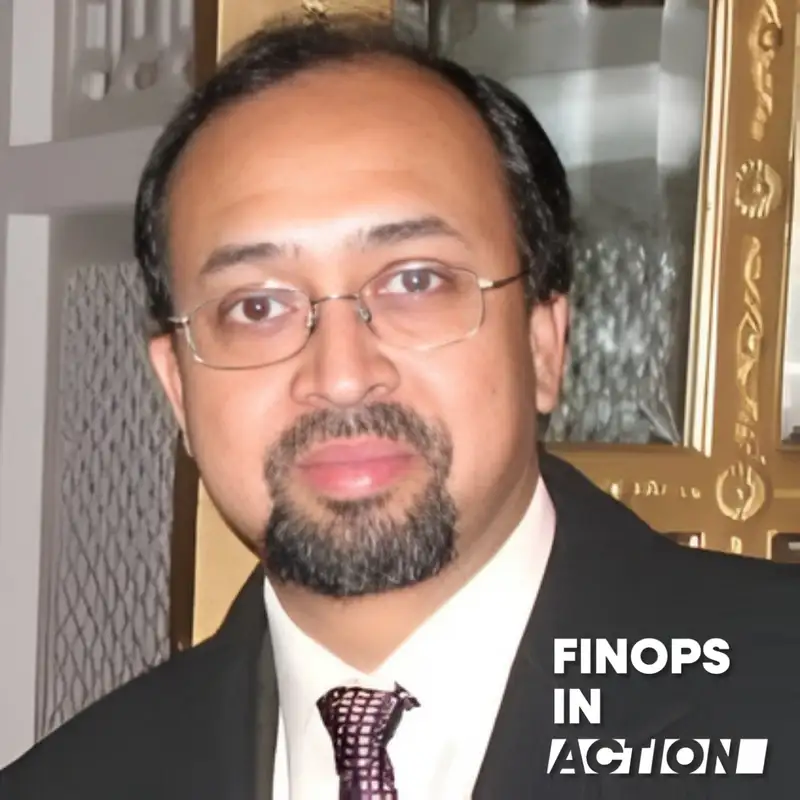
Why FinOps Fails Without People: Power of Centers of Excellence ft. Trig Ghosh, Accenture | Ep #56
FIA - Trig Ghosh
===
Trig Ghosh: [00:00:00] the center of excellence is the driving factor that would fuel the objectives and the path for the FinOps team? would. It would inject the energy into the FinOps team. you have to understand the incentives of all of these different personas. You have to be able to step into their shoes.
Speaker 2: Welcome to FinOps in Action. I'm your host, Taylor Hauck. Each week I'll sit down with FinOps experts to explore the toughest challenges between FinOps and engineering. This show is brought to you by 0.5, empowering teams to optimize cloud costs with deep detection and remediation tools that actually drive action.
Taylor Houck: Hello and welcome to another episode of FinOps in Action. Today I'm honored to be joined by a seasoned professional with over 20 years of project management experience
within it. He's a FinOps professional, a certified FinOps instructor, and a founding contributor to the cloud efficiency hub. Right now he's going super deep [00:01:00] into both FinOps for AI and AI for FinOps. He's a FinOps, SME at Accenture Federal Services. Welcome to the show, trig. Gosh,
Trig Ghosh: It is great to be here with you. How are you doing today?
Taylor Houck: I am doing great tri, and I'm gonna address the elephant in the room. Look at what we're wearing, man. We're so festive. It's Christmas in January.
Trig Ghosh: so honored. Firstly, to be a part of this, uh, club that you founded, uh, the wonderful effort that you, that you led, to wear the same sweater as you're wearing today.
Taylor Houck: Uh, thank you so much, trig. It's been an honor and, And so fun to have you be a part of the journey, one of the over a hundred now practitioners who've become a part of the cloud efficiency hub and sharing our knowledge together. Um, but I don't want to go too deep into that yet. We'll get to the cloud efficiency hub, but, uh, just to kick things off, trig.
I'm curious, you've been doing this for a long time. What do you see people getting wrong in the FinOps industry?
Trig Ghosh: That's an interesting question, [00:02:00] Taylor. My first reaction would be that I probably see people, uh, being overdependent on tooling. So tooling is there to give you. Good information about the steps that you have to take, but I think I see a lot of times people think that the tooling will take the steps rather than the people taking the steps themselves. So tooling is a must. You have to have tooling to get that information. You need to be armed with the information, especially like the kind of information that you guys give out about all the. The hundreds of places where you can, You know, save where you can economize and, and, and have better, You know, cloud spend, optimize cloud spend rather. But people forget that they have to take that step in order to actually see the optimization being done in their organization. The tools cannot do it for them. That is where
Taylor Houck: So,
Trig Ghosh: most people trip up,
Taylor Houck: what does it need? If it's, if it's not tooling or if [00:03:00] tooling isn't quite enough, what is it that is needed?
Trig Ghosh: So people need to understand FinOps themselves as well. They cannot just depend on the tool to understands on their behalf and to take the actions that they need to take, for example. Your tool, say 0.5, tells people to delete snapshots. Right. Uh, snapshots that are old people have to know to, uh, tie that to their business needs and to know exactly how old of a snapshot they can delete or whether a snapshot is three years old, but they still needed for some legal hold or what they have to make that connection between their business needs.
And what the tool is telling them, and then they have to take the action. Sometimes I see people having the attitude that, oh, I've purchased the tooling. There's nothing else for for me to do because now that I have the tooling, the tooling will do everything for me.
Taylor Houck: Can you talk about your, your journey in FinOps and kind [00:04:00] of how you, how you got started and, and came to be where you are today?
Trig Ghosh: Sure. Absolutely. So I got introduced to FinOps quite by chance, by one of my colleagues who just just asked me if I knew what FinOps was. At that point of time, I did not know what FinOps was, so I looked up a couple of YouTube videos. It sounded really, really interesting. And then I, um. I took the certification tests, I think it was a couple of years back in the month of December that I actually cleared the test. And after clearing the tests, uh, the rest is, is basically history because the subject matter is so, so interesting And so compelling.
Taylor Houck: When you go from the training and the test into actually implementing FinOps, what, what did that look like for you?
Trig Ghosh: That was a very interesting journey. Now, I wanted to set up a FinOps, um, of excellence from the very beginning. Like from the time that I was taking the test, I had it in my mind [00:05:00] that I wanted to set up a FinOps center of excellence in my place of work. So I talked with my, um, project, um, um. Project advisor like my boss, basically person who headed a one 20 person, uh, team that, that was doing, um, cloud operations. And I told him in December, after I passed the test that I would like to set up our first meeting with the entire program in December. And he said, do you wanna wait till January?
Because December is not a good one to do that. But I said, no, let's. Uh, let's just have it in December. So the first point is that you cannot wait for the best time to do FinOps. You have to start off whenever. You can just start off. We had a great one hour call with the, uh, with, with about 50% people of the program, about 50 to 60 people attending.
We, we had a lot of animated discussion and it just took off from there. The center of Excellence did not uh, [00:06:00] formally, You know, established in that first call, then the seed was, uh, sewn for the center of excellence to get to, to get created right after.
Taylor Houck: I've got a couple questions. Number one, when, when was it when you were starting your first center of excellence?
Trig Ghosh: This was about maybe about five years back in the month of December though, I do remember that it was in the month of December.
Taylor Houck: And when you brought all those people together, right, it was your first time hearing at FinOps. Perhaps it was some of those folks that joined your, your call, it was their first time as well. Who was it that you brought in together for those initial discussions?
Trig Ghosh: That is a great question. You know, Taylor, because, um, success cannot be a one man show, success always has to be a team, team success. before I set up the first
Taylor Houck: I.
Trig Ghosh: I, uh. talked to a couple of people that were at least on the same, same wavelength as me as regarding, cloud finance, the need to, uh, to be protective of our finances, to not [00:07:00] waste money in the cloud.
And so by the time I, uh, set up my first call, I had a deck. Which had contributions from about four or five different people. So it wasn't my deck, my meeting. It was our meeting with four or five people who had contributed slides, who had contributed their own thoughts and who were willing to speak up in that call. So that was a team call. Where all of these people who probably did not know about FinOps actually brought it to them. They came with the enthusiasm to say that, Hey, we need to stop the bleeding. We need to save money, because that goes towards what, guess what? It goes towards happy hours. It goes towards raising our salaries, goes towards giving our bonuses. So we tied all of these conversations around how it would benefit each and every one of us personally.
Taylor Houck: Yeah, it's so important to get people bought in onto the why, right? I mean, when I first started in my FinOps journey, I was working for a software development company, and the simple fact was that our [00:08:00] cloud bill was growing faster than our revenues were. That's not sustain.
And when you get people aligned on the why, that can get people acting. But who was it? Like who were the people that you brought on the call? Not their names, but their personas. Were these engineers, were they architects? Were they finance people? Who was it that you pulled in?
Trig Ghosh: There was one security and um, security and compliance person. very enthusiastic. He had a strong voice. There were a couple of people, uh, from engineering. one person from, from the PM of finance side who had her eyes on the financial part of it. So it was basically, uh, uh, a collection of people from, uh, from different background who, who, who had agreed to speak up during the call. To people, so it's not just one person's, You know, biased outlook, but it's multiple [00:09:00] from.
Taylor Houck: Absolutely. I mean, that's so important in FinOps. It's something that we hear over and over again from practitioners that have a lot of success is it can't be a one man show. You gotta bring people a lotg for the ride. Um, now let me ask you this. The term FinOps center of excellence is actually not one that I hear that often more often.
I'm hearing FinOps, team FinOps program. What does Center of Excellence mean to you and how is it different if it even is, than a FinOps team?
Trig Ghosh: So the center of excellence is the driving factor that would fuel the objectives and the path for the FinOps team? would. It would inject the energy into the FinOps team. The center of excellence would have, say, a project charter. It would have goals, it would have like short, mid, and long-term goals about where you wanna go.
It would have a set of expectation that, that these, these are the kind of champions we want to, we want to cultivate. These are the, [00:10:00] uh, the objectives of having the champions. These are the responsibilities that the champions will have to do. it's basically a guiding document that would then tell your team what is expected from them, what they should be doing. Going forward.
Taylor Houck: And how is that maintained or used over time? I can imagine it's like super helpful in the. Beginning, Hey, we have this charter. Here's what we're gonna follow. Is it something that stays with you throughout the, the entire program? Are you still using it to this day?
Trig Ghosh: Yeah, that charter would be a guide, uh, guiding light for the entire program. You know, your, your FinOps journey because once you have thought about your, the, the objectives, the goals that you want to reach, then you can refer back to those goals. you have thought about the responsibilities that either each of the champions should be having, then it's easier to, to describe those responsibilities.
Those champions will not be the same. [00:11:00] For, You know, um, the near future or the distant future. So you'll have newer and new people coming into the team. Whenever you have new people coming into the team, it is easier to provide guidelines if you have a guideline document written up so that you can give it to them to read, or you can, you can present it talk about the different facets of the document.
Taylor Houck: So just to go back to the center of excellence. I'm hearing you say you've got this center of excellence that is collection of people from across the organization that have buy-in towards FinOps. You also have a FinOps team, is that correct?
Trig Ghosh: That is correct. We don't have, we don't have a FinOps team, quote unquote. We have FinOps champions.
Taylor Houck: Got it.
Trig Ghosh: None of these people are full-time. Neither was I full-time. FFinOps was just a tiny sliver of my job responsibility and I did it on the side. So, uh, you just have to have the drive and the enthusiasm, and you have to select people from different teams to be [00:12:00] champions who have that same drive, and the enthusiasm and the need to save money for the program.
Taylor Houck: Uh, by the way, I also got started. My, my early days of FinOps were also part-time as I was juggling other responsibilities as well, obviously. Uh, I fell in love with it and, and turned it into a career. But when you're, when you're working with this collective group, right? It, it takes some level of leadership, right?
How, how do you think about, or what is your approach to leadership in FinOps?
Trig Ghosh: Let us take a look at all the different people who could potentially do FinOps, right? So you can have FinOps led by a finance person whose main knowledge base relies in counting the nickels and dimes for your program and knowing when those things are going overboard that you have to cut down on. You can have a project manager who is tasked with helping the finance person cut down on the dollars that you are using for the program. You can have the engineer who maybe wants to do something [00:13:00] make sure that the, that the architecture is, is correct or. You might have an, have an architect working with the engineer to make sure that you're, uh, creating the right solutions. So you have all these different personas, right? To lead a FinOps team, you have to be, you have to understand the incentives of all of these different personas. You have to be able to step into their shoes. That is exactly what I tried to do. So I tried to look at it from the finance person's shoes and figure out what actions need to be taken from their side. Then I had to step into the engineer's shoes. In fact, since I, I'm quite comfortable like doing hands-on work in the cloud, I used to actually work with the engineers do hands-on work when they were not sure of what they were supposed to do. So I had to wear different hats of different personas. That is how I thought I created the cohesion between the different teams that could come together and, uh, and do work together [00:14:00] because I could relate to, to all of these different, different teams, speak their language and do the work a lotgside them. So I'm not just giving them, You know, instructions and walking away, letting them do the heavy lift, but I'm doing the lifting with them.
Taylor Houck: Let's, let's dive in here, right? Let, let, let's talk, uh, let's get practical with it. What are the things these different teams care about? Perhaps we can start with finance and then go to engineering. Like, what is it when you're working with a finance person in FinOps? What, what do they care about and, and how do you work with them most effectively?
Trig Ghosh: So when you look at the finance team, the, the finance team is most interested in, in looking at the cloud spend month to month to month, the cloud spend might increase, might decrease, if the cloud spend increases, what the finance team might not always know is. Why the increase is taking place, or if there's a spike at a certain time, they might not know it's just because, You know, 10 additional servers were either set up because of, [00:15:00] um, of an OS upgrade or, uh, something else was done or there is. There's some kind of a testing going on. There is new code being released. They wanted to set up two new servers to test code. They might not always connect those dots. if I talk to the finance team, get to know their, their concerns, then I'm able to speak to the engineering team, understand what the engineers are doing, why there is a spike on on a certain certain week, or are we expecting the cost to go up in the next month or the next three months. Then I can convey that message to the finance team and build a, You know, build a, build a bridge over there. So, um, the more you understand what these different teams do, the more it's going to help you to make those connections. But let me come back to your leadership, uh, thing over here. You have made connections between people of different groups belonging to different companies all over the world.
So it wasn't only in the us. How [00:16:00] did you get to do that?
Taylor Houck: You are talking about the cloud efficiency hub?
Trig Ghosh: The cloud efficiency hub. Yeah.
Taylor Houck: Absolutely. No, I'm happy to, to talk about that. And for anyone listening that's not familiar, the Cloud Efficiency Hub, uh, you can find it online@hub.pointfive.co. It is the. Most comprehensive knowledge base of cloud inefficiencies that exist in the world right now.
And it's free, it's public, and it's open for everyone to take a look at it. And the way that it was built is through essentially crowdsourcing the knowledge of FinOps practitioners that are doing this work every single day within organizations all over the world. Pretty much trig. The thesis is this.
The thesis is, Hey, we have so many different platforms today. I mean, you've got AWS Azure, Google Cloud, Oracle Cloud. You've got new providers and, and kind of like pass offers like Snowflake and Databricks and Datadog, I mean even can be looped in here. Essentially, [00:17:00] all these different providers and services that leverage different and unique usage-based pricing models and these usage-based pricing models are very complex, and we all know that this leads to inefficiency within cloud environments, especially.
At scale when you're leveraging many, many of these different cloud services. Now, when you are an experienced practitioner and you've been doing this job for a while, you start to really know and understand the billing models and how to use them within the services that you're using every day. The challenge is that every company uses a different.
Mix of these services, right? So you may have one person on, on one hand that's super, super deep in a KS, right? Azure Kubernetes, but doesn't know a thing about an AWS, You know, Aurora database.
Trig Ghosh: Mm-hmm.
Taylor Houck: So if they were to get a new application in their scope that was on a service they were not familiar with, they've gotta start from ground one and do all the research to figure out what the heck.
Do I [00:18:00] even do? What do I look out for within this service? So essentially we had this idea of we can go out and enlist knowledge from the community to build a central knowledge base of these inefficiencies so that when you're getting started on a new service, you can just go in and, and, and search the collective knowledge base and find what you should be looking out for.
Uh, it turns out that. This thesis was, was partially true and people resonated with this idea. And also the FinOps community as a whole is one that really leans into knowledge sharing. We can get to pretty soon, you, you, yourself are a, a FinOps instructor, so I know you hold this true to your heart. Um, but people were, You know, it didn't take a lot of, uh, a lot of chasing after folks to get them to come and contribute their experience, I'll tell you.
And that's, that's really when we knew we, we got something right is when we realized that people were. Coming in and, and happy to share and, and it kind of felt like it came together naturally.
Trig Ghosh: So you were ask, asking me about the center of excellence. [00:19:00] You have set up what I would call a center of excellence. Of the different ways in which you can optimize costs in the cloud. And I'm, and I'm pretty sure that, You know, you have the world a favor by, um, by providing this for free to all the people. And I'm pretty sure that your company, which is, which is like a leading company, You know, with a flagship product, you are probably gonna be implementing a lot of those.
Taylor Houck: Hey, thank you. Thank you so much, Trigg. I I really appreciate that. I will say this podcast is not intended to be a 0.5 sales pitch, but yeah, a absolutely it does, uh, lean into what we do. Um, now we do think that software can help solve the problem of. Identifying and, and searching the land for these inefficiencies, especially within at scale, You know, environments where it's not feasible for a person with their hands on the keyboard to look through all the resources that are configured.
But that being said, it still is a super helpful resource that people can use when they're [00:20:00] doing this job every single day. You don't need a product to start implementing best practices outta the cloud efficiency hub.
Trig Ghosh: Yep. Very good. So, a lot of the things that you did are that I had done to, You know, connect with people. So the fundamentals are the same. The ways that we operate are different just.
Taylor Houck: Absolutely. Uh, I'm curious, getting back to our, our earlier conversation, this actually leans really well into it because we talked about, Hey, what does finance care about? And your answer was, Hey, they care about, did cost go up and down? What is my cost versus budget and what's. The number, right? What is my monthly cloud spend?
Hey, are you throwing cash out the door for an upfront reservation? Like those are the things that they care about. When you work with engineers, what do, what do they care about?
Trig Ghosh: The engineers care about deadlines. They care about deadlines. They don't want to have any failures. So they, they wouldn't mind over provisioning because they just want their systems to work properly without [00:21:00] any, uh, failures, any issues. So you have to, um, convey to them the importance of, yes, we don't have want to have any issues, we don't want to have any issues with our monthly costs, You know, spiking either. So it's always a conversation of, uh, two different perspectives, meeting.
Taylor Houck: And how do you work with them? Let's say like the cloud efficiency hub is a great example. We have a list of pretty much all these potential inefficiencies that could exist within any given service. Let's say you, you found, I don't know if you might have an example even to share about a specific inefficiency, um, that you were able to, to resolve.
How, how do you bring that type of thing to an engineer and, and get them to, You know, take it seriously?
Trig Ghosh: You make them owners of the problem and the solution, and just because it is, uh, teamwork and not an individual is trying to shine. You give them credit for what they have done. [00:22:00] So you talk to them, you ask for suggestions. You talk to them about problems, about the costs rising month after month or even, know, for a certain, for a certain week. talk to 'em about those costs. You, you have them solve that cost issue and then you give them recognition. So whenever we had these, uh, these monthly meetings for FinOps about the FinOps Center of Excellence or anything else, there used to be, uh, a slide in the PowerPoint deck that was devoted to the people who went above and beyond their, uh, uh, their job responsibilities in order to do something that went towards reducing costs. So you have to incentivize them. You have to make them a part of the team rather than, uh, have them feel that they're at the periphery. You tell them what to do and they do it. It doesn't happen that way. They have to feel like they are the ones who are deciding [00:23:00] what to do, and they're the ones who are doing it.
Taylor Houck: Now these are, these are golden nuggets and ones that You know are so true to, to follow and, and practices that we've heard from so many people. And the, the reason why you're probably hitting on all the right things, trig is, is you actually are a, a FinOps trainer yourself. Can you tell us a little bit about how, how you got into this, and maybe even how being a trainer has helped you along your FinOps journey?
Trig Ghosh: Sure. Absolutely. One of my good friends, Rick Triana, who, who was actually the guy who encouraged me to, uh, to go in for the pH professional certification.
So I went in for the pH professional certification, after that. Went ahead and did everything I was supposed to do in order to become a trainer. And then Accenture signed the training partner contract with the FinOps Foundation, or the Linux Foundation, whichever you wanna it. And then Accenture became a training partner of the Foundation. has been very, uh, rewarding. [00:24:00] As, uh, as an activity, I have trained a bunch of, uh, people inside Accenture. I have trained, uh, Accenture clients. It's just been very rewarding and I do have to mention Rick's name once again, Rick Triana, for his, uh, support over here because had it not been for him, I wouldn't have done it. And I did receive a lot of, um, support from my MDs, Mike Eisenstein and from Kevin Harris. Solid, You know, solid support for me.
Taylor Houck: I, I actually have a question that I, I would love to ask a FinOps trainer. Can I ask you, what is FinOps?
Trig Ghosh: Uh, let us take a step back, okay. To ask about what is it to work in the cloud? [00:25:00] So firstly, you need to have a good architecture, right? You need to have architects would design a good architecture. And the reason for the good architecture is what, firstly, your product has to work correctly. It has to do what you're wanting it to do. secondly, it has to be cost effective so that you don't have runaway costs. So that is the architecture part. The second part is, uh. Talking about maintenance, product has to be maintainable, right? So you need to have engineers who can the product when it goes wrong. You have to have proper change management process in in place.
So we talk about change management, You know, c, CB, we have, we have a ticketing mechanism. We have all of these things, right? And then, and then lastly, you have the, uh, financial. So if, if you look at all these different angles, there is one, one common thing from all these different angles and any other angle that you think of.
There is one thing that is common to everything, which is money. [00:26:00] Dollars, the green bills, that is where FinOps comes in. So FinOps has this lever of the, the green bill, the dollars, and this lever moves every other lever. It's connected to every other lever. So basically FinOps teaches, Even though it teaches it only with respect to finance, but finance has its bearing on all these different aspects. So you become a responsible engineer, or responsible architect, or responsible, You know, uh, management professional because you are being asked to do that by something called the.
Taylor Houck: What an answer, man. It's awesome because inops is something that the word is so thrown around these days, and sometimes I wonder if. [00:27:00] People even know what it means. And I actually think that different people have different definitions, but I think that you just did an amazing job, uh, explaining it shrink Now, FinOps is something that's been around for a while now.
It's not so new anymore, but things are changing so fast. How do you see FinOps kind of shaping in this world of ai?
Trig Ghosh: Oh, that's a very interesting question. So, um. We are now in the world of ai. AI is growing, FinOps is growing with it. There is, there is definitely a very strong connection between FinOps and ai. Now that AI is giving us all the tools, firstly, to use natural language, like NLP as it's called, uh, to do a lot of our work, the natural connection between FinOps and AI comes where now the end user is now using NLP to get their, uh, You know, to get their information that they need rather than [00:28:00] going through all these mouse clicks. So if you look at AI from, uh, from two aspects, right? From, from the aspect of. FinOps for AI we're using, and a company that provides AI solutions is actually doing FinOps to reduce their AI costs.
So that is one perspective. The other perspective is Uh, using FinOps to reduce your own AI consumption costs. So you are a consumer and you are trying to reduce your FinOps consumption costs by doing ai. Um. Both of these areas are growing and will keep on growing. So it's gonna be a very, uh, very interesting couple of next years, I mean, next couple of years rather.
Taylor Houck: Are you, uh, bold enough to give me a prediction?
Trig Ghosh: I am not bold enough to give you any predictions right now, but what I will will say is, um, we are in [00:29:00] a honeymoon period right now where we are able to use, uh, of LMS for very little cost or for, You know, for free. This will not last forever. At some point, the money is going to dry up and all of these services are gonna be very expensive. The question is, how do we wanna that world where AI usage is expensive? Just because people are not pouring so much of, uh, You know, r and d money into ai, like for research and development purely.
Taylor Houck: Trig. That is such a good point. I've heard people mention before, it's like, do you remember when Uber and Lyft were first getting started and you could call a ride and it would be like three or four bucks that
Trig Ghosh: Mm-hmm.
Taylor Houck: That doesn't exist anymore? Right? It's because. Investors were subsidizing some of those rides to, to get [00:30:00] users.
And perhaps the same thing is happening in AI right now. No matter what happens over the next few years, we know that AI spend is gonna go up by a lot,
Trig Ghosh: Absolutely.
Taylor Houck: Getting more expensive themself, or maybe even they're gonna get cheaper, but way more people are gonna use it and we're gonna find way more use cases no matter what the spend is, is gonna go up most likely.
And it's gonna be really interesting to see how it all plays out, and I know you're gonna be a part of it. Um, thank you so much. This has been such an incredible discussion with Trig, gosh, from Accenture Federal Services. Trig. Before we sign off, anything else the, uh, the audience should know about you. I mean, we don't just do FinOps, right?
We're more than that. We're people.
Trig Ghosh: We're human beings. Yeah. Well, uh, in my free time, I, um. I go to this fantastic club called Toastmasters. It's uh, for public speaking. play the harmonica in my freedom as well. And uh, if there are people [00:31:00] around who really love me, then I can sing in their presents if they promise to not run away.
Taylor Houck: Wow. I did not know this about you. I did not know this about you. And now I, I hope I can make it on your list. Um, and we'll get to hear that one day. But trig, it has been an incredible episode. Thank you so much for coming on.
Trig Ghosh: Same here. Taylor. Thank you so much for your time and thank you for your sweater.
Taylor Houck: Absolutely. And to the listeners, I hope you enjoyed this episode of FinOps in Action. Uh, we'll be back for more next time. Thanks again, trig.
Outro: That wraps up another episode of Fit Ops in Action. Thank you for joining. For show notes and more, please visit fit ops in action.com. This show is brought to you by 0.5, empowering teams to optimize cloud costs with deep detection remediation tools that actually drive action.
Creators and Guests