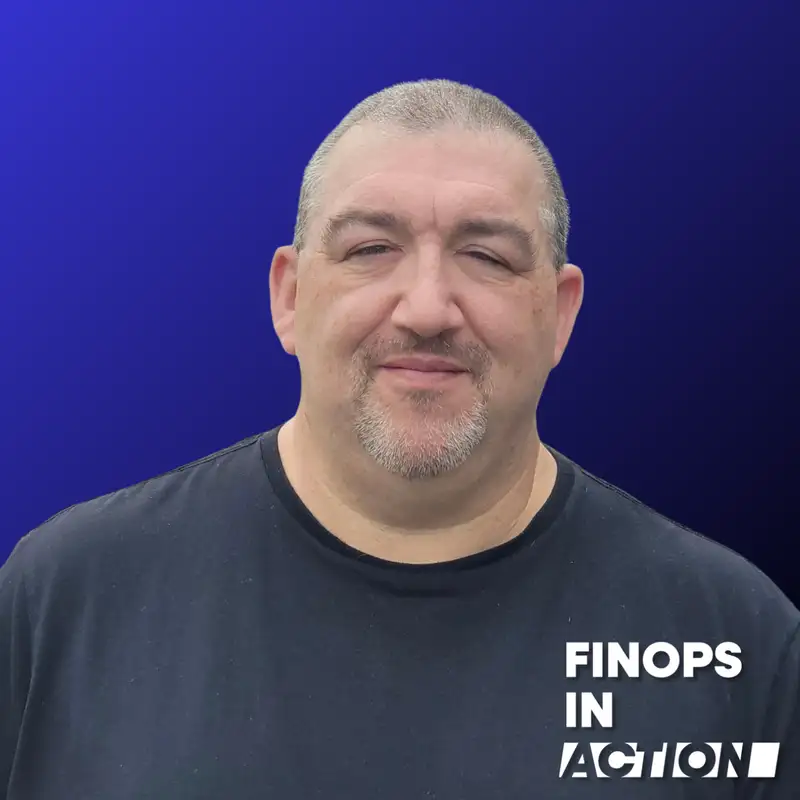
How to Reduce Cloud Costs Without Sacrificing Performance ft. Jason Ward, C.H. Robinson | Ep #64
FIA - Jason Ward
===
Jason Ward: [00:00:00] what engineer that gets paid decently is going to go care about saving $86 a month. when you have, say, 3000 of those recommendations as an engineering team as a whole, that's a lot of money.
But to one engineer, that's, that's nothing that, that's a waste of their time to go look at that. So if you can figure out to get a leadership buy-in and figure out how to start automating that process or looking at architecture from the get go. Then those wouldn't be there in the, You know, may not be there in the first place.
Intro: welcome to FinOps in Action. I'm your host, Taylor Houck. Each week I'll sit down with FinOps experts to explore the toughest challenges between FinOps and engineering. This show is brought to you by 0.5, empowering teams to optimize cloud costs with deep detection and remediation tools that actually drive action.
Taylor Houck: Hello, and welcome to another episode of FinOps in Action. Today's guest brings a really strong mix of technical depth and real world FinOps experience. He has spent more than 15 years across infrastructure, [00:01:00] cloud, architecture, and platform engineering. He has driven more than $500,000 a month. Cloud cost avoidance at a Fortune 500 company and is an expert in Azure Kubernetes in automation.
He was also one of the first people to get certified in FinOps for ai. Today he serves as the lead FinOps practitioner at C.H. Robinson. Jason Ward, welcome to the show.
Jason Ward: Hey, thank you. Thank you for having me.
Taylor Houck: Absolutely. I, I'm super excited to talk with you, Jason, and you bring a really interesting perspective because when you joined C.H. Robinson, they didn't have a FinOps team.
You didn't have FinOps in your title. How did you start doing this kind of work?
Jason Ward: Uh, man, probably back in 2009, 2007, uh, I started, I was a mechanic and I was just kind of getting wore outta doing that. And, uh, college ITT tech called me out of the [00:02:00] blue. Um, doing their like cold calls and asking if I'd be interested in sign up for their computer networking degree. And I thought, why not? So I did it and uh, from there I just kind of started building on, I went into Geek Squad for a little bit to get more of a hands-on computer experience. I wasn't really into computers that much until then. And so that kind of just taught me a little bit about the OSS and how to do certain things that they do. then from there, I knew people in school that got on at a data center. And then I got on at 1&1 Internet from, uh, it's a German web hosting company. And, uh, I was a data center tech. Then I became head of their build and run team, managing a 55,000 square foot data center with about 20,000 servers and 8,000 networking devices in there. kind of helped build the team from the ground up and kind of give them a new image and kind of responsibilities. And then from there I moved to a managed services data center, um, for called DataBank. from there I went to a company called Cerner and got into cloud. They're an EHR company. was there for [00:03:00] probably five, six years and then left there when they were getting ready to be purchased by Oracle then got in at C.H. Robinson as a senior cloud engineer. And then from there, yeah, I just started, uh, the role, I started kind of getting tired of doing the whole support thing and helping, not necessarily the helping part, but doing the same monotonous stuff over and over. A ticket would come in, you look at it, what's going on? You fix it. I wanted something a little more. Interesting. And so I talked to my manager and he was like, well, we need someone to kind of look at this cost thing a little more that you've been bringing up. And I was like, give it to me. And I just took it and ran with it. And I've been doing it for the last two, two and a half years.
Taylor Houck: You have a really interesting background and experience kind of working across all of the kind of technical development and evolution of, of technology as a whole. When you, when you moved into the cloud world, when did you recognize that cost was gonna be a really important metric for engineering teams to manage?
Jason Ward: honestly, it was probably after [00:04:00] about th two and a half, three years being at Cerner, you could kind of see how quickly costs would ramp up. Um, using tools like New Relic for logging, you would realize how expensive that would get or how expensive queries could get for databases, right? And people running that stuff and, but I was never in a position to do anything.
I tried a few times to kind of get into that, more of that like a lead engineer role to kind of have the responsibility to look into that, it just never panned out. Um, but once I got here to C.H. Robinson, they were awesome about anything you want to try do. They'll do, You know, they're like, go for it. And, uh, and that really let me push on and, and get to where I'm at now. As I started seeing costs and, and in Azure and how to look at that stuff, it just kind of drove my curiosity, if you will, and I was able to start really diving into that. I,
Taylor Houck: talk to me about the very early days of you managing FinOps at C.H. Robinson. What kind of prompted the investment and focus on on cost, and what were kind of the first steps that [00:05:00] you took in starting that FinOps journey?
Jason Ward: kind of with, with Microsoft, they come in and like once a year they'd kind of have their own consultant come in that works for them and kind of do these ops assessments with you and kind of go over. All the Azure recommendations, what they mean, how they look, uh, where to find orphaned resources, um, You know, and then breaking out the recommendations into misconfigured, Kubernetes deployments, or two large Postgres databases and, and kind of get you to kind of see where you're at, um, and what you could save if you were following better practices. And so they needed somebody to kind of work with them hand in hand, and kind of look at that stuff and devise a plan. And that's where I came in. I was like, yeah, give it to me. I'll, I'll do it. uh, and from there I just worked with them off and on, and then started kind of figuring out how things work, started doing my own research into FinOps, then I just, I from there, I, I went in and started diving in head first.
Taylor Houck: I feel like a lot of us that have worked in FinOps for a while, when we think back on the kind of earlier days of our. Journeys. There's [00:06:00] usually some, some event, some project that kind of, uh, found some significant savings, and that's how we all caught the bug to keep going. Can you, uh, tell us about some of the early, early wins and savings that you were able to achieve?
If anything comes to the top of your mind?
Jason Ward: Yeah. First thing is uh, uh, it's kind of a pro and a con in that area is like VMs and right sizing. People have a tendency when you do infrastructure as code to just copy, paste, copy paste the configs from other people that they think they may need. so I found that looking at that, we had a ton of VMs and VM skill.
Uh. Scale sets and Kubernetes that were completely misconfigured or mis mis, um, I'm to think of the right word here, but basically built on the wrong SKU sizing. They were just, people would see 'em, they would just copy someone else's config and just build it up, even though they were just running docks on it and they needed, they were asking for 60 fours, eight gigs of ram when they needed like eight. [00:07:00] So, You know, and, and looking at that, I was able to get with a couple of my teammates and do a complete, uh, VM audit. go through and start right sizing the right way, and not just listening to what recommendations said to do, but actually looking at their usage, looking at the metrics, and then giving them an idea based on that.
Taylor Houck: You come from an engineering background, so you probably understand the perspective of engineers when you show up and tell them that, Hey, you've got 64 gigs of RAM today and I want to put. Two on eight Sometimes that can, uh, not have the, they, they may not accept that, that perspective right away. They may push back.
I mean, a lot of folks performance is, is number one, right? They want to be able to scale. They want to configure for the maximum potential utilization that they could see in any given scenario. How do you work with engineers to make sure that their perspectives are being considered while also prioritizing cost?
Jason Ward: good question. 'cause that was kind of one of the first mistakes I ever made was just assuming [00:08:00] that when. Something came in and said this was wrong. You know, it wasn't correctly sized, that you could just say, just fix this, make it this. Um, but then the eng, like you said, the engineering side kind of kicked in and you talked to 'em and you realize, kind of get the understanding of their service.
So we would meet with them. Then kind of get the understanding of how their service is being built or their app was being built and why it needed certain things. Um, You know, one example is we have a team that has a service where, when you look at the recommendations, the way that they've got it built out, you would think it's just complete waste, but it's not actually waste.
They use it because it's certain times it needs to scale up rapidly and always have those available. So you kind of have to just look at it and go, okay, that's a business use case. So we're just gonna have to let that be. You know, and it, it just really helps to talk to the teams on a one-on-one level and coming in as a cloud engineer, you already know how they're kind of building it anyway. but being able to actually have that conversation and report with them, it lets you see a little deeper into their architecture. And if You know, and, and go from there, I.
Taylor Houck: It, it's so [00:09:00] important to put yourself in the shoes of the engineers that you're working with. Right, because oftentimes as a, a Fit Ops person, and this is especially for, You know, any of the listeners that perhaps don't come from a, a hardcore engineering background, you could come in and, and think that you have an easy win, right?
And that you have a, a recommendation that can just save however much money it identified. It could be a thousand dollars, it could be $10,000. It could be a hundred thousand dollars, but. You may not recognize that the engineers that are responsible for the infrastructure, they're the ones that have a pager.
And if there's performance issues in the middle of the night, they're gonna be getting outta bed at three in the morning to to fix this, right? So you gotta put yourself in those shoes and make sure that what you're proposing, you really have the data to back up the fact that it's not gonna cause them to have to jump outta bed in three in the morning.
Jason Ward: Yeah, exactly. And that's, that was kind of the main problem we first had when we started getting into FinOps was we could get reporting tools, um, for, You [00:10:00] know, Azure. We were using like the FinOps toolkit that they have. And it was great because it was showing us costs. Again, it was very reactive and not proactive. Um. it was given us that information. We could see certain resource groups or certain resources that were, You know, definitely going up in cost. Um, but it was lacking certain things because it wouldn't give us any use of metrics. It wouldn't give us the actual real world data of the service. So we eventually went and switched tools and, and now we're using Datadog for a lot of the, we use 'em for observability. Um, but we did a POC with them for their cloud cost management tool. And that's been kind of a game changer for us because we can use that tool and not only look at the cost usage, but now we can bring in all the usage metrics per service, per database, per vm, whatever the case may be, and show that to an engineer and say, look, I, I know you're saying you need it, but here's 60 days of data that show you've never gotten close to what you're requesting. You could be requesting [00:11:00] four cores, but in the last 60 days, you've used one and a half cores. So you don't, this proves you don't technically need all of what you're showing, and then that can lead into the discovery of like, okay, explain why you think you need this.
Taylor Houck: I want to get, talk about some specific wins because I, I heard you before we started recording, talk about, um, an AKS cluster that you might have, uh, uh, found some significant savings on. Can you tell us a bit about, about that story and, uh, it came to be.
Jason Ward: Yeah, it was just, uh, it was one service on one cluster and they, uh, they're very, uh, they were very resource intensive and that was kind of one of the ones they constantly were requesting four and six cores, but only ever using maybe one to one and a half, maybe two cores at most. we kept kind of talking with them over time and they were like, we need this.
We have to have this. But we kept hearing the use case, but the data didn't support the use case. So we were able to kind of watch it again over time and really talk to 'em. And they were like, okay, let's look at it. And we're like, look, you don't even have to take it [00:12:00] down to what it recommends. Just take it down.
Let's start it, knocking it down at core. Let's knock it down, maybe two cores and let's reassess. they were like, okay, we can do that. No problem. So they did it and within like two or three days, they were going from a max, I think of like $286 a day down to like 30. So, I mean, it saved that much just by not, even going to what the full recommendation would be, just kind of tuning it a little bit and cutting back on some of their skill sets. You know, and it was, yeah, it was a big one. 'cause it saved quite a bit.
Taylor Houck: I mean, I'm no fan of public math, but that's like 90% savings, right?
Jason Ward: Yeah. It was a lot.
Taylor Houck: That's insane. I mean, that's. It keeps you going in this in.
Jason Ward: does. And, and, You know, and, and it's kind of hard 'cause like you said, not you. When you're not even hearing it from the engineer perspective, You know, they, nobody wants to do it. But when you can show wins like that, You know, and you kind of keep it for, on certain occasions like your mbrs kind of have, instead of like a wall of shame, I always try to go like with a wall of fame [00:13:00] kind of deal.
Like, You know, You know, they're very competitive anyway. And so to be able, engineers are in general or competitive. So if you can say, Hey, this team's up at the top of the board and they've been able to save this much, You know, it's just by a simple looking at a retuning, know, it's, it, it helps.
Taylor Houck: This is the perfect transition point into kind of moving from FinOps as a one-time project to a, a practice. Right. In, in your experience, what, what has been important or useful to you? As you started building out a real FinOps program within your organization.
Jason Ward: Oh man. I would say consistency. You, you have to stay focused. You have to stay consistent on what you're doing. And, um, You know, it's always easy to start with a low hanging fruit that, that's simple. No. You know, the low hanging fruit always works. But the real hard part in FinOps, for me anyway, is not low hanging fruit.
Actually digging in and finding, okay, we've knocking. away those [00:14:00] easy wins. What else can we do to keep this going? And that's where I think have to start looking at, You know, getting other people involved. And not just talking to the desk, but talking to their managers, talking to, um, other engineer architects and You know, and getting leadership buy-in as well, because you have to start looking at it from a design perspective at that point. You know, and if you can stay consistent, show the savings, then get them to understand the buy-in of why they want to consistently do that. Not just do it when they're asked to do it.
Taylor Houck: Executive buy-in is something that has come up in a lot of these conversations. Why do you think it's so important and what do you think is the best way to get executive buy-in?
Jason Ward: Oh, I, I think it's important personally, myself, because. Without that executive buy-in, you take, and I could be out of touch here, but most engineers, from my point of view coming through don't care so much about the bottom line. They don't care so much about saving the company money. [00:15:00] It, it doesn't ever really go back to them a lot unless it's, know, something huge. leadership. they have a tendency to see that. And if companies that have like chargeback methods, they're responsible for their budgets, they're responsible for their forecast. If they don't meet it, then they're asked why. If you don't have that buy-in or you don't have that chargeback method, then it, it still never really fully affects them. don't, I don't think anyway, personally.
Taylor Houck: Yeah. It's like how do you get people to care? You actually charge them for it, right?
Jason Ward: Yeah. I mean, you, you kind of have to, it's, it, it, it's kind of like. Recommendations. Going back to that, know, you see some recommendations. It's like, oh, you could save 80 bucks a month. Well, what engineer that gets paid decently is going to go care about saving $86 a month. when you have, say, 3000 of those recommendations as an engineering team as a whole, that's a lot of money. But to one engineer, that's, that's nothing that, that's a waste of their time to go look at that. So if you can figure out [00:16:00] to get a leadership buy-in and figure out how to start automating that process or looking at architecture from the get go. Then those wouldn't be there in the, You know, may not be there in the first place.
Taylor Houck: So we talked a little bit earlier around how You know engineers can sometimes push back rightfully so many times on optimization recommendations. Have you seen similar resistance when you started charging teams for their their cloud spend?
Jason Ward: Oh, well, we actually haven't started charging teams yet,
Taylor Houck: Why not?
Jason Ward: that's, Um, that's something that I am truly trying to work on, but it's with us, it's kind of like only been really focusing on this for the last two years, and we're still very much in the lower. You know, the lower phases of FinOps, we're still very much crawl, walk phase, if you will. So it's, we're just not there yet to do that. Um, my, one of my main initiatives this year is to get tagging policies in place because if I can get that in place, then we can truly show the allocation amongst all the services and [00:17:00] really break it down because I can't offer, even propose a chargeback if we have no way of breaking that out.
Taylor Houck: Yeah, that's, that's absolutely fair. Um, kind of shifting gears once more to something that you, you said earlier, which is that, hey, you can sometimes have, You know, optimization opportunities that are very, very small in dollar amount. Right. Potentially not worth someone's time to take a look at and execute.
Right. But if you have many occurrences of that, like the death by a thousand paper cut, uh, scenario, then it is worth addressing. How do you, how do you handle scenarios like this? And have you come across any in your, uh, FinOps journey?
Jason Ward: Yeah, we, we currently are, and that's something we're working on because, um, You know, one of the things we're trying to implement is a lot of your VPA and HPA auto-scaling with a lot of these workloads and Kubernetes. Um, some of the issues that we're run into with like Azure is they have a hard. Stop at a thousand pods per per node.
So you can't really run VPA on anything over that. And [00:18:00] whenever a lot of our services are 2000 plus pods, You know, you kind of get into the part, well, how do we handle this? So now we're starting to look at other ways of, of doing this and not being reliant on a tool so much. So there's some different things like shard deployments.
I just started looking into trying to figure that out. Something I really don't know a lot about. Where you can break a deployment up into like shards, they all function normally, but it'll, you can cap it or have it lower pod count per each shard. So then you can run VPA on those. And then once you start tuning those, you can move into like your horizontal pod.
Out of scaling, well start scaling nodes or scaling back nodes based on usage.
Taylor Houck: Kubernetes is a really interesting topic and I, I, I think I recall from our prep that you guys are actually running a, a hybrid environment between the cloud and a data center. Is that correct?
Jason Ward: Correct. Yeah. So we have our a KS clusters as well as we have our, uh, rancher clusters on, on-prem. So we're running everything there and we're trying, that's another area we're trying to slowly focus on and figure out how to get the data center costs brought in. [00:19:00] So that's where I've been kind of digging in and, and trying to look at it, the data center part and working on like a, uh, rate card.
So where I can look at all the power, the PUE, the, You know, I can look at everything together and make like a, full annual or monthly cost and then try to break that down cost per hour per node, and then use math from there with our usage metrics to start breaking that cost out.
Taylor Houck: Yeah. It's funny because it's like when, when especially folks that are, are very cloud native and are, are used to operating outta the cloud, it's like you, you don't just get, you don't get a billing file for rack servers in a data center. Right. It's just there. Now you're paying for it in a lot of different ways.
How do you like. I know you just mentioned some of the ways you're thinking about it, but like how are you planning to actually track costs of your on-prem resources?
Jason Ward: So I, it kind of goes back to tooling. You could use like open telemetry and run one of those agents on those nodes. Or like we're using, like I said, we use Datadog, so we have an agent running on all of our [00:20:00] clusters that are on-prem, And so it returns all of the usage metrics back to our dashboard. So from there, with those usage metrics down to a namespace level, you can take that with the math that they put in there to apply to our cost per node, per hour to kind of break it out and we can start looking at resource usage and cost that way.
Taylor Houck: in general, how do you think about where to run a specific workload, right? Because I mean, the, the promise of Kubernetes is you can run it anywhere, right? You can pick it up and run it in, in any cloud provider or even on-prem, how do you figure out? Where you're going to run it. And is there a particular type of, of workload that you, You know, intentionally place in the cloud versus on-prem?
Jason Ward: That's one of the areas that I'm, I'm also trying to focus on. So, You know, like I said, it's, it's the. The deal with being newer, right? You're kind of finding this out as you go and, and ideally my end goal is exactly that. I want Dev to be able to look at a workload and decide based on data points, what would be the best solution for them to run their, so run their app or service in. Um, and [00:21:00] hopefully with we get the cost correct down to namespace level. We could, we could have 'em deploy two places, compare 'em, say run it for a week and say, You know. you go. Um, ideally I would think, You know, your on-prem would be better for your more stable static workloads, where cloud you need disaster recovery or ha or multiple regions and it's easy to do in cloud.
So could work on tiering your apps or services based on business need, and then you could go from there and, and kind of decide what would work best.
Taylor Houck: Do you have any plans to get out of the data center entirely?
Jason Ward: Not that I know of. No, no, not, not that I've seen.
Taylor Houck: It's interesting because a lot of folks I've heard that, that that is like the path that they're on, right, is get completely out of the data center and completely cloud.
Jason Ward: I don't fully, I don't know if that's all the way the best thing to do, You know, I mean, 'cause if you're connected directly to your data center, You know, you can, there's a lot of benefits there. I know cost is always high, but in some cases, cost isn't always higher on a data center than it is in cloud for certain workloads. So, [00:22:00] You know, and it financially, it may not always make sense to just ditch. the data center, um, especially one of the things we're running into is capacity for AI workloads and GPU node. A lot of people are running into that and in Azure right now, it's you, it's almost impossible to get certain GPU workloads where if you physically buy a server and have it in your data center, you have access to that workload.
It's yours. You're not sharing it with anybody else anywhere in the world. It's your, your hardware. So in that case, You know it makes sense. Now the cost initially may be higher, but over time I think you would see a better ROI.
Taylor Houck: it's gonna be really interesting to see how it all plays out. And I, I do want to get to the topic of, of AI and we will soon, but before we do that, um, my understanding is that you are a full Azure shop in terms of your cloud environment. Is that right?
Jason Ward: correct. Yeah, we're, we're like 90% Azure. I mean, there's some sprinkles here and there for testing, but no, we're, we're a bulk of an Azure shop.
Taylor Houck: If you were, I'm gonna paint a scenario for you and I, I want to hear your, your perspective. If you had a, let's say a [00:23:00] family member that came to you and they said, Hey, I, You know, just got a new job. I'm running engineering at this company and we have a huge Azure footprint. I don't know anything about it.
Our costs are very high and I have to start thinking about managing and optimizing the spend. Where would you tell them to start and what advice would you give to this, this friend of yours as they embark on this journey specifically for Azure?
Jason Ward: I would say for, for that, the first thing I would do is, um, ask them how long, You know, they could run it or how long they've been running it. Um, because it's hard to optimize stuff that when you're just starting out, You know, there's, there's not really an easy way to do that 'cause you don't have the historical data to base anything on. Um, but just starting out, I would say look at the recommendations that Azure can produce. Not necessarily follow it to a T, but just look at as a starting or an investigation point and start kind of looking through there. If it says, You know, you need to resize something, look at the usage, go into your monitoring in Azure. Look at the [00:24:00] usage. Does it make sense? If it does, maybe start looking at the teams and asking them that. Um, the other thing I would suggest would be tagging. Make sure you have a good tagging policy so you can begin to costs out so You know where that spend is going instead of just seeing a blob of spend and then having no idea what went up, why it went up, or where it went up, You know, from, so tagging would definitely be the top of the list.
Taylor Houck: No, those are great, great points and, and perspectives and it, it's so important to be on top of that, um, early on in your journey. Now, I, I do want to transition back to the topic of ai. It's kind of the hot topic right now. Everyone's talking.
Jason Ward: Yeah,
Taylor Houck: I think that, You know, with, with the rapid acceleration of the capabilities of these new models, people are using them more than ever, and I, I don't see a world where that slows down.
You, you were one of the first people to be certified in FinOps for ai. What are you thinking about as it relates to AI spend?
Jason Ward: it's, it's hard because, You know, [00:25:00] AI is that space where people are just trying to jump on it and go without looking at any repercussions. at the same time, you kind of have to, right? If companies want to be at the top of their game using AI and integrating it correctly, don't wanna look at cost, they don't wanna think about it.
So you have to kind of be a little reactive at this point. So it's best to know different scenarios you could use. as far as like, uh, modeling ai cost by model or by tokens and figuring out the, the cost that way, because there's certain, if you look no, if you don't know, right? Output tokens can cost more than your input tokens.
So that's one area you want to kind of look at. So even though, You know, a company say would have to build quickly into the AI space, at least you can give 'em the data points of, look at your tokens, kind of get an idea of where you're at, input and output wise. Try to pick a model that fits the base. Best cost per performance and start there instead of just picking the newest, greatest model, thinking it could be the best and then bad inference.
Configuration. Something could, could have [00:26:00] thousands of dollars gone in an hour as opposed to, You know, really just at least thinking about it first.
Taylor Houck: You know, there, there's so many considerations, and as I was mentioning, there's the, the, the Excel. Acceleration of the capabilities of these models. More people are using them than ever. By the way, many folks that were not even engineers are using these products and generating cost. Um, we're seeing, at least it's with our customers.
It's interesting because for the past couple years everyone's been talking about FinOps free ai, AI for FinOps, but. The reality is that within enterprise organizations, AI spend was still like less than 5% of the total spend that we, that they were seeing. But it almost, it, it's like since December of 2025, something has shifted and we're starting to see the, the growth of spend on AI workloads rapidly accelerate.
Yeah.
Think this is something that's going to come to bear, um, at some point. It's like the, the focus is [00:27:00] still on innovation for now, but eventually. We're gonna need to justify the spend in these areas. And the reality is there's a lot of ways that, You know, you can optimize spend on AI without even having to cut back on, on exploration or, You know, uh, testing new capabilities.
Jason Ward: Yeah, very true.
Taylor Houck: I, I'm also curious on the other side, how you're using AI to accelerate your FinOps journey, because I, if I'm correct, you are the only. Full-time person at your company that's focused on FinOps, how are you thinking about using AI to scale your, uh, your function?
Jason Ward: I would love to find a way, and I'll be honest, I have no development background at all, so it's kind of harder for me to get involved in that. But what I really like to do is just try to create a FinOps agent. could run locally or that we could have hosted on our stuff that could go and query our cost data to be able and then integrate it into teams. Um, so that way, You know, we could easily just ask, You know, about our [00:28:00] cost and, and kind of go from there to connect to like an MCP server and just have everything, You know, done that way. I know the FinOps toolkit offers one of those now. Um, it's just a matter of getting it integrated or having time to work on getting stuff like that integrated, but ideally that would be one of my end goals for that.
Taylor Houck: I think it's gonna be amazing to see, just like even, let's call it a year's time. I think what we're all doing every day is going to look, uh, different. I, I could be wrong, but it's gonna be interesting to see, uh, how it all plays out.
Jason Ward: Yeah, I am really curious. I mean. there's, it's one of the biggest growth areas right now, and you're right, there's a lot of people that aren't even technical that are asking to automate stuff, and they're just jumping in feet first without really taking a look and trying to figure it out and without having the right guardrails or constraints in place to not stop them, but just give them ideas. It could get crazy really fast if, if they don't, You know, kind of keep that in mind.
Taylor Houck: It's gonna be fun. Um, that's for sure. But Jason, just as we, as we transition towards the end of this episode, I [00:29:00] think that we've all learned a lot, a lot from you. But now perhaps it'd be, it'd be great to learn. Um, about you. And I think that, You know, especially for some of our, our listeners who are earlier in their careers, it'd be really interesting to hear, You know, you.
Started from Geek Squad and are now running FinOps for a Fortune 500 organization. When you look back on your career and what has caused you to, to have so much success, what advice would you give to someone who is, say, in the, the earlier stages of their career and hoping to, You know, build, um, a strong career in technology?
Jason Ward: I would say just kind of pick a path that you, that interests you and stick with it. Um, because if it's not interesting to you, you're gonna lose kind of focus on it. You're gonna lose interest in it, and you're just not gonna, You know, give it the right attention it needs. Um, You know, like FinOps for me, it, it, it peaks my curiosity all the time.
There's so many different rabbit holes you can dive into it allows you to, if you wanna hyperfocus on something, you can, [00:30:00] and you could get real granular with your thoughts about it and really be able to nitpick things apart. And I think that's important in tech in general. If, if you just come in with a wide umbrella at first, kind of see what gets your interest and then start narrowing yourself down over time, it'll allow you to really pick the right path for you.
I think.
Taylor Houck: That's, that's excellent advice. And, and Jason, I also, uh, recall from our, our prep that you, uh, have an interest in 3D printing. Can you tell me, uh, a bit about that and. What are you using? Uh, 3D printers to build.
Jason Ward: Uh, mostly honestly, I like action figures, stuff like that, like different collectors pieces. So I, I have a resin printer, which is, it's a little bit more high tech than your normal 3D printer. It takes filament. You have to buy like this liquid and that use the UV light and then it'll drop down and create these, uh, different things. So I just use it to pretty much do that. And then I paint them on the side too and, and kind of just make my own collectibles. So I figure it's cheaper than spending like $1,200 for a. Slideshow, collectible or something like that. So
Taylor Houck: No, that, that's super cool. And I'm actually, I don't [00:31:00] know much about 3D printers. What is it? What kind of liquid does it use and how does it.
Jason Ward: uses it's resin, like, um, it's like a different type of viscosity of material. It's a resin. There's different types and it, uh, solidifies or cures with like a UV light. So you can, it has this tray and then the thing drops down into the tray and just each layer instead of like, um. A 3D printer that has filament will just make these little layers of plastic all around. This takes a layer of liquid use, a UV light to, to, uh, cure it immediately, and it just keeps building up those layers over time. But with a resin printer, you get much finer details as opposed to like one of those ones that makes those like 3D printable, um, You know, like the little dragons and stuff like that where you can see a bunch of lines and stuff.
This makes really precision based
Taylor Houck: Where do you, where do you like design it? Is there like a software application that you design in it?
Jason Ward: yeah, you can, there's like different 3D programs you can get like Tinkercad or, um, now with ai, AI even does it, you can [00:32:00] take an image and create a 3D file and have it make a printable file. Um, a lot of times though, I'm no artist, so I just go out and find different, different people that make the stuff and you can buy the files from them, and then you just download it and it on your printer.
Taylor Houck: Super cool man. Super cool man. Um, hey, where can people find you? Listeners who, uh, maybe heard this conversation? Wanna learn more, uh, want to get in touch with you? Where is the best place for them to, uh, find you and get in touch?
Jason Ward: Ah, LinkedIn. Honestly, that's probably about the best place with this kind of stuff, honestly.
Taylor Houck: Awesome. Well, Jason, this has been, uh, fantastic. Thank you so much for coming on the show,
Jason Ward: Yeah. Thanks for having me.
Taylor Houck: and thank you to our audience. If you learn something today or got something outta this conversation, please share this episode with someone who needs to hear it. This has been another amazing episode of FinOps in Action, and we'll see you next time.
Outro: That wraps up another episode of Fit Ops in Action. Thank you for joining. For show notes and more, please visit fit ops in action.com. This show is brought to you by 0.5, [00:33:00] empowering teams to optimize cloud costs with deep detection remediation tools that actually drive action.
Creators and Guests